
Looking for Mister N: On the Trail of the Nebbiolo Grapes. Prologue
/A new year. A new beginning. A new adventure.
This is the account of a nearly 1,000-kilometers journey from the famous Langhe to the little-known Valcamonica (the south-western and eastern borders of the Nebbiolo’s production area) I undertook between April 2015 and October 2019. Along the way I interviewed more than twenty winegrowers who shared with me not only their memories about their land, but also their knowledge about viticolture and winemaking, history and geology, and their thoughts about landscape changing, global warming and future challenges. This is the Prologue. If you like, you will find a new chapter every two weeks. Enjoy!
At the beginning of April 2015 –after nine years of research on my first book on wine, La Barbera è femmina![i]– my journey on the trail of Barbera grapes had not come to an end, and yet I could not wait for a new adventure to start. Since 2006 I had mainly travelled across Piedmont and the presence of Nebbiolo grapes had become more and more insistent along the way. I had come across Nebbiolo so many times that inevitably, at some point, it caught my attention.
Apart from a similar amount of sugar –that is, similar high potential alcohol content after fermentation– the two grapes, Barbera and Nebbiolo, could not be more different. In some way, they were complementary to each other. One lacked what the other seemed to be full of.
First of all, Barbera had high levels of malvidin –a chemical compound called “anthocyanin” giving to wines their typical bluish red color– and loads of tartaric acid, but a small amount of seed tannins. On the contrary, Nebbiolo had a large amount of seed harsh tannins, but small quantities of malvidin and lower acid levels[ii]. Moreover, Barbera was very sensitive to flavescence dorée –the most serious grapevine disease yellows in Europe– while Nebbiolo seemed to be immune to it. But the most striking difference was that the former was grown nearly everywhere in the world, while the latter was cultivated in a very small area confined to Northwest Italy (Piedmont and Lombardy).
What about the wines made from Nebbiolo grapes? Unlike Barbera, whose name is usually mentioned on wine bottle labels, the word Nebbiolo vanished from them, hidden behind the name of villages (Barolo, Barbaresco, Fara, Sizzano, Ghemme, Boca, Gattinara, Lessona, Carema, Donnas), hills (Roero and Bramaterra) and valleys (Valtellina). I had been told over and over again: even more than nobility, that was the key strength of Nebbiolo: the ability to vanish, and become terroir.
During that summer, a series of questions inevitably arose in my mind. What was Nebbiolo’s origin? What about its interaction with different kinds of soil? What vine training systems had been selected to produce the best grapes? What varieties shared the scene with it? What about the impact of climate change over time? What was the role of history in affirming its success? And finally, how did globalization influence land and soil exploitation? How did it reshape the landscape? Did it determine the success of the wines and the price of the bottles? And if so, how?
Complex questions, since Nebbiolo is a complex vine, and his is the story of a prince becoming a king: a sort of Henry V of the wine world, regal and charismatic, one of those heroes whose deeds remain shrouded in myth, between light and shadow. How could I resist him?
So, one day I opened the atlas, equipped with colored markers and Post-it notes, and I started to highlight his route by combining geography and history. Geographic data showed that the route traced by Nebbiolo vines was short, circumscribed and scattered with names dropped all along the way like small white pebbles in the woods: Ilciù vinasca (more marc), Ciù venasca (with vein, vigorous) or Chiavennasca in Valtellina (1), Martesana in the Como area (2), Prunent in the Ossola Valley[iii] (3), Spanna between Novara and Vercelli (4), Melasca in the Biella area (5), Picoutener or Picotendro in Carema and in the Aosta Valley (6). And finally, Nebbiolo in Piedmont, south of the River Po (7).
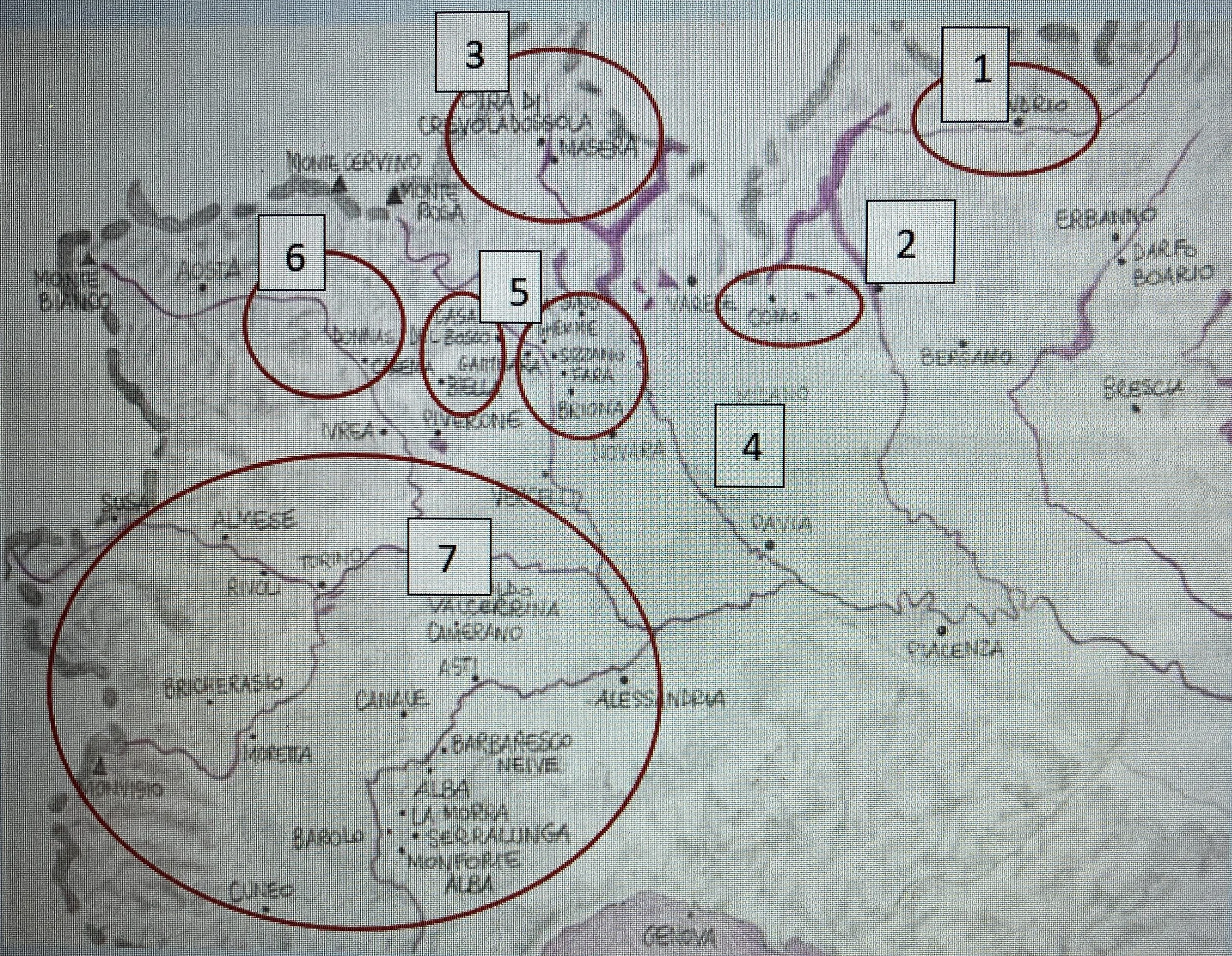
Unfortunately, the intersection of geographic areas and names did not shade any light on the matter; on the contrary, all those details seemed to make the pattern even more intricate.
What about the historical data? The earliest attestation of the word Nibiol, dated 1266, was in a document relating to some vineyards in the surroundings of Rivoli, about 12 miles west of Turin. The second, dated 1287, was in a lease on a vineyard near Alba (filagnos de vitibus neblorii, “rows of Nebbiolo vines”). The third reference to Nebiolo, dated 1295, was in the last will of a certain Tommaso Asinari who bequeathed his wife four barrels of wine from his vineyards in Camerano, near Asti (duos de nebiolo et duos de nostrali, i.e. “two barrels of Nebbiolo and two of the local wine”, probably Barbera). Rivoli, Alba, Camerano... As I found new toponyms, I added more and more circles: Moncalieri (1303), Canale (Nebiolio, 1303), Asti (1304-09), Susa (1305), Masera (Pryinetu, 1309), Chieri (1311), Moretta (Nubliolio, 1324), Almese (1327), Bricherasio (1328)...
I still remembered what Luca Rostagno (winemaker at Matteo Correggia Winery) had told me six months before: in the summer of 2014, during an interview for my first book, at some point he had defined Nebbiolo as a wild grape from Piedmont, very demanding, which responded to all the weather oddities. That was a fact. But all those different names seemed to suggest that Nebbiolo also liked to hide, and assume new identities.
Fog, fog season, bloom[iv]: before taking up residence within a small area delimited by the Susa Valley, the Langhe and the Asti area, what mists had Nebbiolo emerged from? Someone had tried to give an answer.
In early 2004, professors, journalists and wine producers from all over the world gathered in Sondrio, Valtellina, to speak at the first international conference on Nebbiolo Grapes. In front of a large audience the renowned geneticist Anna Schneider presented an incontrovertible fact resulting from DNA analyses: in Valtellina there’s the greatest number (six out of ten) of genetically related grape varieties to Nebbiolo. This data left room for a fascinating hypothesis: that Nebbiolo had not spread from the Langhe to Valtellina, as people had always thought, but the other way round.
For some reason, much of the wine world accepted this hypothesis as an undisputed truth. Was it, therefore, a real Copernican Revolution? It suddenly seemed that the Nebbiolo wine universe, centered around Barolo since time immemorial, had started turning around Valtellina, the true geographic origin…
But the matter is in reality much more complicated. As the investigations of the CNR of Turin have shown later, if we consider the ten grape varieties related to Nebbiolo (Negrera, Rossola, Rossolino nero, Brugnola, Bressana, Chiavennaschino, Vespolina, Neretto di San Giorgio, Bubbierasco and Freisa):
Negrera, Rossola, Rossolino nero, Brugnola, Bressana are confined to Valtellina (1 red line);
Chiavennaschino is cultivated only at both ends of the route, that is in Valtellina and in the Langhe (locally called Rosé Nebbiolo) (5 blue line);
Vespolina is present in Alto Piemonte, North Piedmont, and in Oltrepò, South Lombardy (2 green line);
Neretto di San Giorgio (or di Bairo) is grown in the Canavese area (3 yellow line);
Bubbierasco (son of Nebbiolo and Bianchetta di Saluzzo, a local variety) is planted in the Saluzzo area, near Cuneo (4 brown line);
Freisa is grown all over Piedmont, but not in Valtellina (6 light blue line).
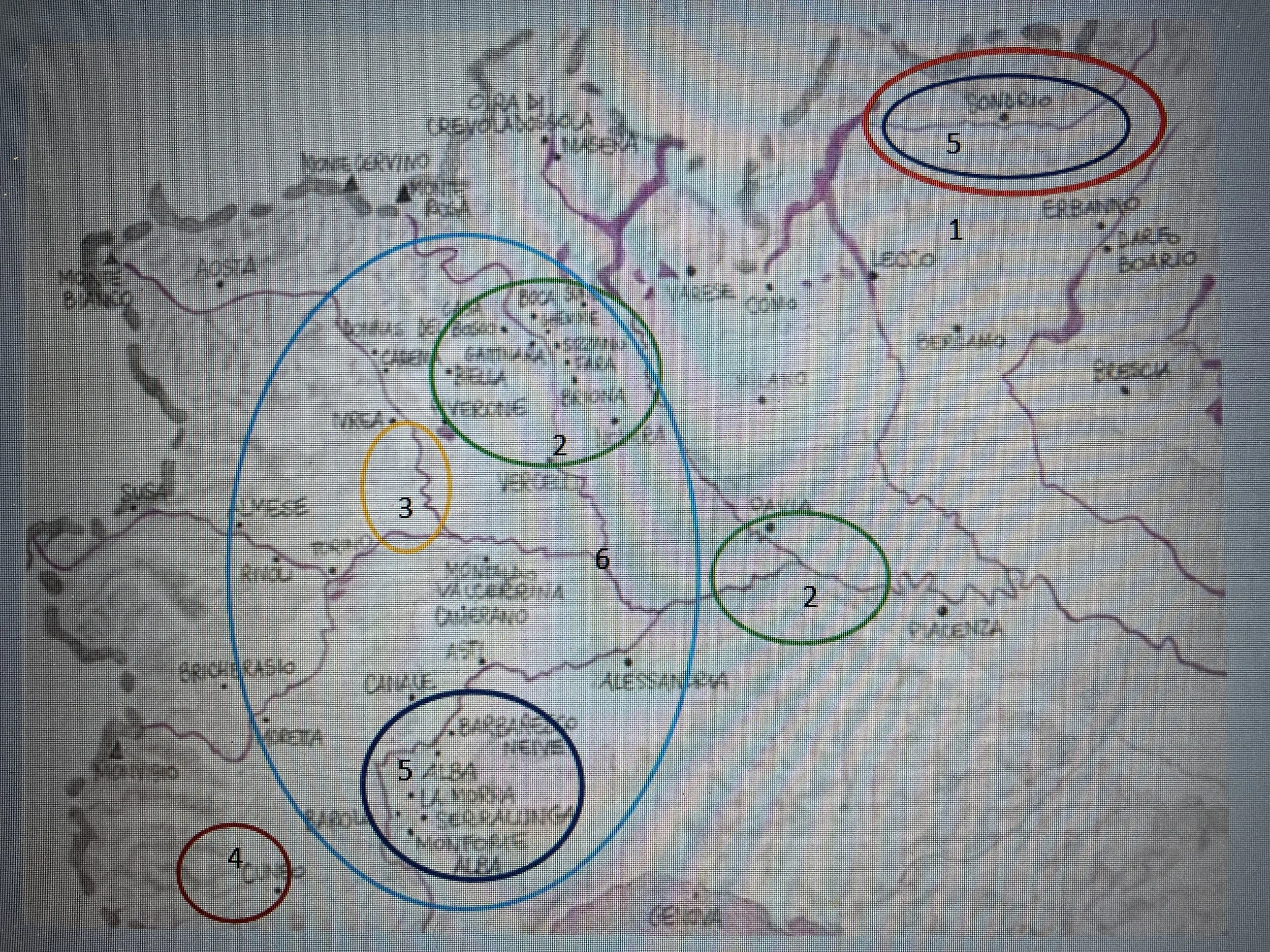
Unfortunately, those data could be interpreted in two antithetical ways. Given the decrease in the number of related varieties as we move from northeast (Valtellina) to southwest (Langhe), we could assume that a kind of dilution has occurred as we move away from the area of origin. Or, on the contrary, given the increase of the genetic variability of the seven identified genotypes[v] as we move from Valtellina to the Langhe, we could assume that Nebbiolo has arrived in Valtellina much later: in other words, as Anna Schneider would say, “the older the variety, the longer it may have been exposed to environmental stress and have accumulated mutations. Furthermore, a great clonal differentiation could reflect the long-term interest of winegrowers and winemakers in the selection of clones”[vi].
Not to mention the arrival of Phylloxera[vii] and the clonal selection in the late 19th century which could have seriously altered the spread of the different genotypes.
As Anna Schneider would have summarized fifteen years later, “considering the only existing genotype in Valtellina, which does not even seem ancestral, I get the impression that there’s less differentiation in Valtellina, which could suggest a more recent presence there than in the other areas. But I’d just like to emphasize that this is only a hypothesis”[viii].
An answer which leaves no room for interpretation.
At the time of my research, among the eight grape varieties genetically closest to the Nebbiolo genotype Lampia (in order: Negrera, Freisa, Rosé Nebbiolo, Vespolina, Bubbierasco, Brugnola, Rossolino and Rossola) a first-degree kinship was demonstrated, but not the direction: were they Nebbiolo’s parents or its children? Impossible to tell. And even less was known about partners... Basically, its origin remained obscure.
Some scholars had identified Nebbiolo with an ancient variety, Spionia or Spinea, cultivated near Ravenna[ix] around two thousand years ago and cited by the Roman authors Pliny the Elder (23-79 AD) and Columella (4-70 AD), and by the Greek writer Strabo (62 BC – 24 AD). The identification based on a curious coincidence: on the one hand, the similarity with the name Spanna, on the other, the etymological analogy between Prunus spinosa (wild plum) and Prunent (local genotype of Nebbiolo in the Ossola Valley). That theory, however, did not convince me at all. In Roman time Nebbiolo might have been grown in the Ravenna area, but it seemed to me hard to believe that a vine planted in a watery area (definitely the wrong place!) could have been noticed because of the quality of the wine produced. If there existed a very demanding variety which could not be exported anywhere, that was Nebbiolo: they had tried to plant it in many areas of the planet, from California to Oregon, from South Africa to New Zealand, but the wines produced had not been lived up to expectations –in other words, they didn’t smell or taste like Nebbiolo. Obviously, climate could have shuffled the deck. But I found it hard to believe that Nebbiolo had produced a decent wine in a humid and marshy area. Or, even more so, that its environmental requirements had changed so dramatically in two thousand years.
Nevertheless, there were many similarities between the ancient Spionia and Nebbiolo. The Spionia mentioned by Pliny the Elder in Naturalis historia was a variety enduring the heat, fattening with autumn rains and mists (nebulis), somehow “fed” by them. In other words, it was a late variety with a resistant skin to withstand both heat and rain. Moreover, according to Columella in De re rustica, Spionia’s clusters were larger than numerous, just like Nebbiolo’s. As for Strabo, in Geography he had limited himself to writing that the vines planted in the marshes around Ravenna –which he never calls by name– grew quickly, produced a lot of grapes, and died within four, five years –perhaps just because they were planted in an unsuitable place and got exhausted?
But even assuming that the ancient Spionia and Nebbiolo were the same variety, this did not help give answers about its origin: unlike other varieties, it had left no trace behind. All evidence seemed to have vanished, as if Nebbiolo had come out from nowhere. No trace of having been either in the east or in the west. No presence either north of the Alps or south of the Langhe – in fact, its cultivation in Sardinia dated back to the 18th century...
With a blue marker I followed Nebbiolo’s footprints along the course of the River Po and six of its tributaries (clockwise: Tanaro, Dora Riparia, Dora Baltea, Sesia, Ticino and Adda) until they suddenly stopped as they met the Alps. Therefore, the route I traced on the atlas was just a short main blue line curving with tentacular branches from southwest to northeast –a rather small area after all, if you consider Europe, surrounded by a huge empty space. Yet, its DNA had been compared with that of 1,500 varieties from all wine-growing areas of the world. Unfortunately, the analyses had given no results. Perhaps the geneticist Anna Schneider was right: the puzzle could only be solved on condition that the elements (parents and partners) had not “already disappeared, swallowed up by the continuous evolution of the varietal assortment”.
Beyond the boundaries of that small area, there was no trace but a faint one: the presence of Viognier, an aromatic white variety genetically related to Freisa, originally cultivated only in the northern Rhone valley, France. According to legend, Viognier had been originally domesticated on the Dalmatian coast (now Croatia). In the III century AD it was brought to the Rhone valley by the Roman emperor Probus (born in Pannonia, present-day Serbia) when he reintroduced vine cultivation after Emperor Domitian had banned it during the widespread grain famine in 92 AD. If that was the case, long before crossing the Alps and reaching France, part of Nebbiolo’s genetic heritage would have already been present much further to the east of Ravenna, on the Balkan route... Perhaps the history I was trying to retrace was older, wider, and more complicated than I thought, extending not simply from Friuli to Piedmont, but from the Caucasus to the Basque Country.
Nonetheless, what made Nebbiolo absolutely unique was not its obscure origins, but rather its elusive nature, and its unparalleled invulnerability –two qualities apparently independent, but in fact intimately connected. Prunent, Picotendro, Chiavennasca and Spanna were not only synonyms of Nebbiolo. They were biotypes (just like the biotypes grown in the Langhe, Lampia and Michet) which differed from each other in the look as much as in the wine produced, despite the nearly identical genetic code. When it came to Nebbiolo, no one could unambiguously state, as for Barbera, what clusters, or leaves, looked like because of its incredible phenotypic variability. In fact, it manifested itself with such heterogeneous morphological characteristics that the numerous existing biotypes seemed genetically different vines: each differed from the other for vigor, weight of the fruit cluster, wine grape production, quality of the wine and suitability for aging.
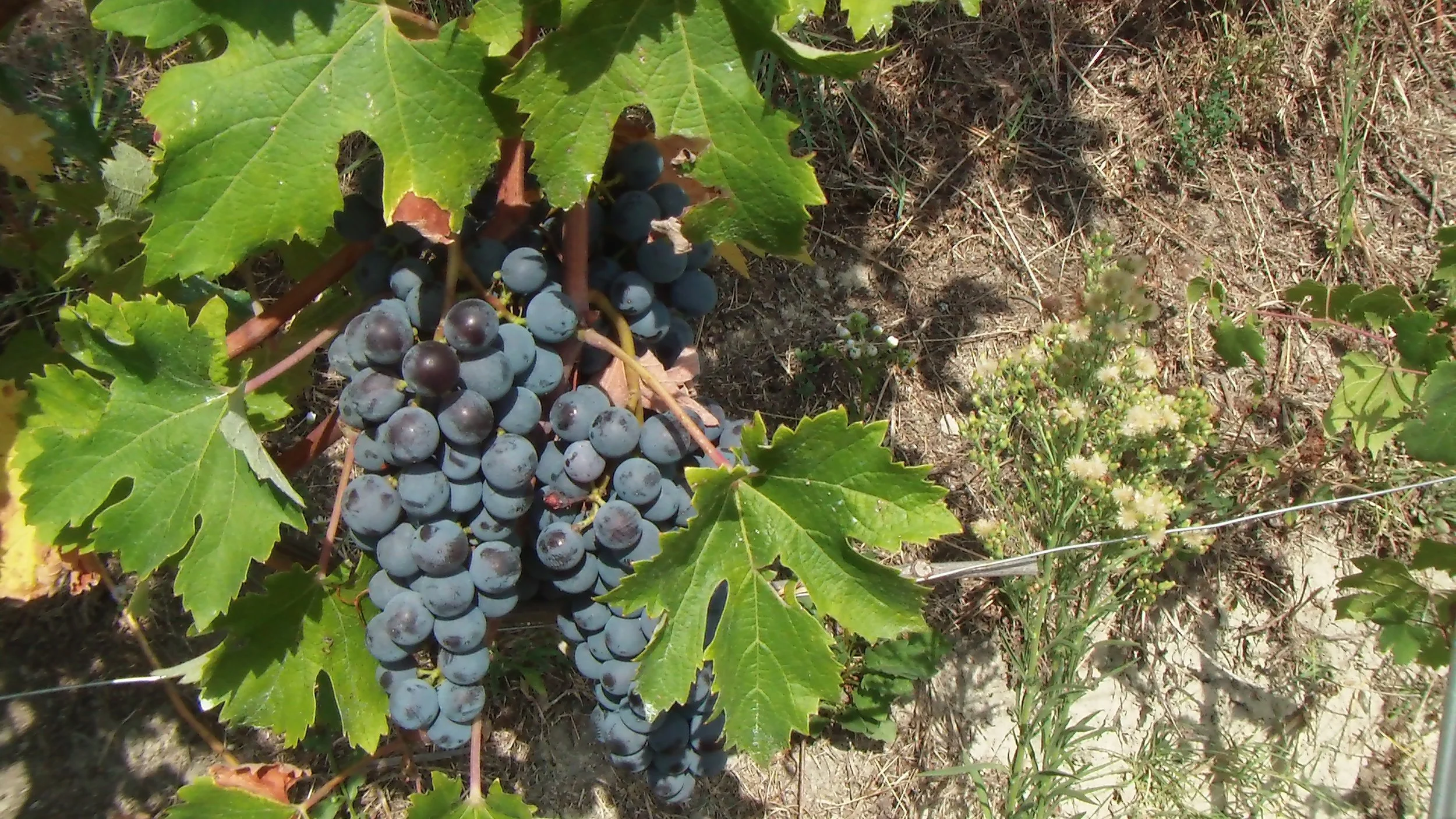
michet biotype (monforte, langhe)
In addition to the phenotypic variability, there was another factor that differentiated Nebbiolo from most of the grape varieties: about a quarter of its genes seemed to be involved in resistance to disease and stress. Both its higher resistance to attack by pathogens and its quick-change artist’s nature (sometimes sides of the same coin, as in the case of Michet type, actually a Lampia strain affected by viral infections) were the result of a long interaction between its specific genetic code (the genotype) and a specific habitat.
Hence, its multiple identities and the objective difficulty of making an identikit. Nevertheless, some elements common to all biotypes could be grasped:
Spherical berries and thin but resistant skin, with shades from purplish to black-bluish, but always covered by a thick layer of greyish bloom.
Early budbreak and flowering. Late veraison and ripening.
Upright and orderly posture. Longing to spread its branches far. Plenty of energy.
Low distal (close to the trunk) bud fertililty. Apical buds (fourth and fifth) fruiting. According to viticulture manuals, perfect for training systems such as guyot.
The Prince of Grapes had a noble posture and was fond of masks and camouflage; he was very resistant to pathogens and was practically immune to flavescence dorée (also called golden yellowing). In him, even a genetic defect, far from being its Achilles heel, became a strength.
So, who was Mister N? I had no idea. One thing was clear though: he had been conversing with many soils, different microclimates, and various humanity for thousands of years… At least, I knew where to start now. I had to retrace his steps. Because there was not only one Nebbiolo. There were many. As many as the number of lands he had passed through. And they were all authentic.
[i] “La Barbera è femmina!” (literally, Barbera is Female!), Roma, Edizioni Estemporanee, 2016. It has not been translated into English.
[ii] Though their low levels of malvidin, Nebbiolo grapes have high levels of cyanidin, which is another type of anthocyanin (pigment). Although abundant, it tends to precipitate in the early stages, due to its tendency to bind to tannins, determining the typical garnet/orange hue.
[iii] Prunent is the local biotype of Nebbiolo grapes, which can be mentioned on the labels of “Valli Ossolane” besides the word “Nebbiolo” according to the product regulation for Controlled Designation of Origin (DOC) “Valli Ossolane Nebbiolo” wines.
[iv] A white coating on grapes, which protects grapes from losing moisture and decay.
[v] The seven genotypes have been identified basing on 98 Nebbiolo clones (40 included in the Italian National Register of Grape Varieties, selected from mother plants scattered in the typical areas of ‘Nebbiolo’ cultivation, and 58 collected from old plants, aged 70-80 years). The survey (whose goal was to cover most of the areas where ‘Nebbiolo’ was and is currently present, analysing the most ancient plants typical of each area) showed that only one genotype (B) was present in Valtellina, two (B/D) were present in the Ossola Valley, three (B/D/F) in Donnas, Carema and Canavese area, four (B/C/D/F) in North Piedmont (Alto Piemonte) and five (B/D/E/F/G) in the Langhe, while the biotype D is present all over Piedmont except in Valtellina. See G. GAMBINO et al, Whole-genome sequencing and SNV genotyping of Nebbiolo clones, Nature, vol. 7, art. 17294 (2017).
[vi] From an e-mail written to me by Dr Anna Schneider on October 29th 2018.
[vii] A microscopic louse or aphid, living on and eating roots of grapes, brought to Europe unknowingly by Victorian-era botanists through American native vines. Around 1860 it decimated Europe’s vineyards.
[viii] From an e-mail written to me by Dr Anna Schneider on October 29th 2018.
[ix] Roman town located in a lagoon on the Adriatic coast, northeastern Italy, 89 miles south of Venice and 26 miles north of the Po delta.