
Looking for Mister N: The Langhe, the Sea. Chapter I
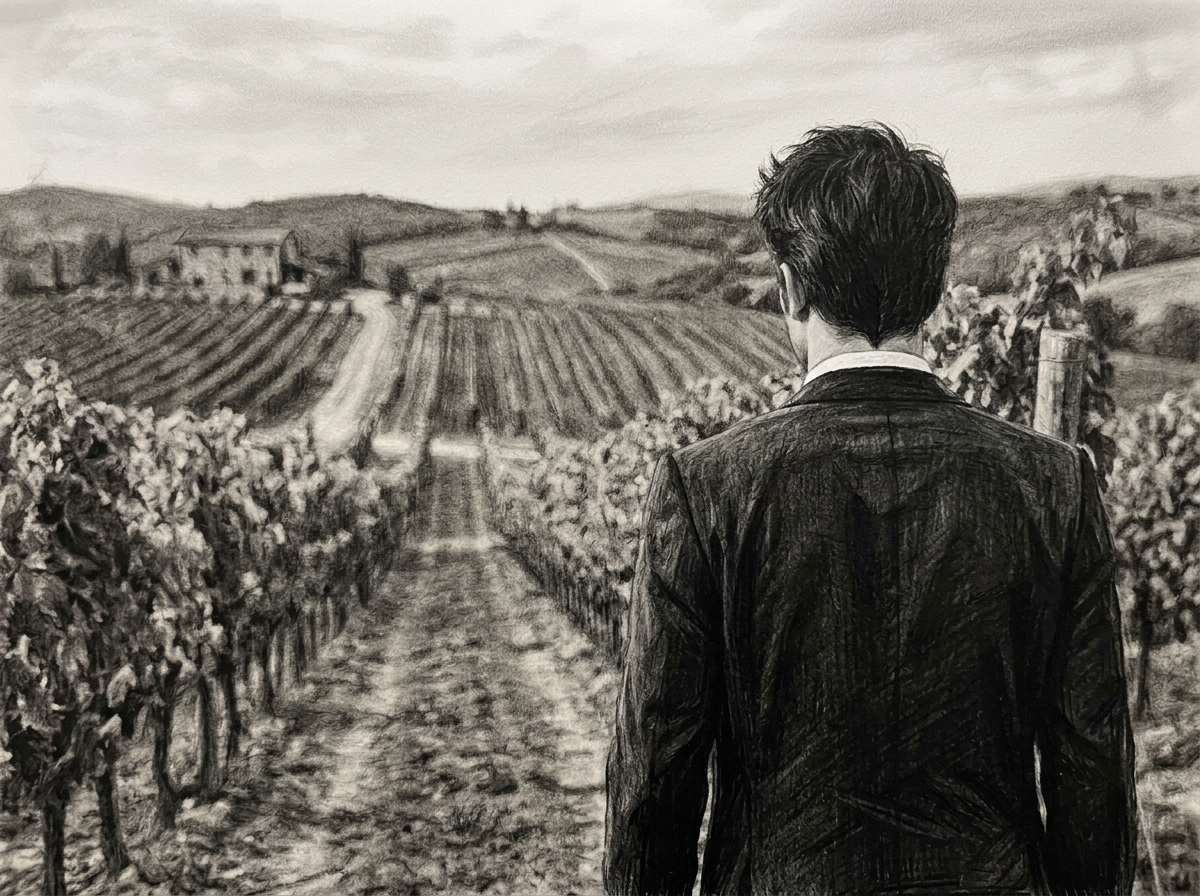
/“…The hills around him, covered in vineyards and woods, form a natural amphitheater. Streams have sculpted those beautiful hills over time. One in particular has carved the soil by penetrating sands, grey marls, and sandstone, and now it has taken a bizarre shape: an eagle claw stretched out in the act of grabbing its prey, or a gnarled tree root creeping into the rock. A spooky coincidence predicting both the predatory nature of that land and the strong survival instinct of those vines.
N watches the blue claw-like stream from above as it grabs those three tongue-shaped strips of land –not hills to him, but waves of light foam, long and low, running towards a lower seabed, where they suddenly rise, majestically break, and roar, and roll, into the shoreline, and finally dissolve... When he opens his eyes, he thinks he can actually smell the salty scent of the sea. A strong, fresh wind has risen from southwest and now is blowing from behind his back. Here it is called Marino. As he takes a deep breath, he is immediately assailed by visions and flashes from the past, perhaps only dreamed of: sea shell fragments scattered all around across the beach, and his feet immersed in the brackish water of an eastern lagoon...
N observes with his gray eyes the resilience of the woods on one side, and the supremacy of the vineyards on the other. Suddenly he looks down at his hands, staring at the spider-web veins on their back. His skin is so pale, so transparent. He’s so skinny. Like a marathon runner, he hides his strength under some semblance of frailty. He wears an Italian cut suit, a little out of place on that hill. The woods and the vineyards: which of the two describes him better? The woods call him, relying on his noble and wild side. But the vineyards –which obsessively occupy most of the landscape– attract him like a magnet (or like a moth?) by counting on his dark side.
As he enters the maze of those concentric vine rows, unexpectedly he is led on a very different journey and soon gets lost, catapulted back in time, into the dark cellars of a noble palace, and then forward, to the royal tables of European courts, to a commercial port, on an ocean-going ship, to an office on Wall Street, into a restaurant in Singapore...
Visions and flashes, again. Those vineyards awaken his most unscrupulous, cosmopolitan and glamorous side, and bring out his competitive nature which wants to win everything at all costs, and succeeds. Either gambler or stock market player, it doesn’t matter. It is the smell of blood that brings him back on those hills. It is the deafening pulse of that hypertrophic unholy heart, beating right in the middle of those hills, a huge visceral tangle of inextricable interests...”.
About Geology
Let us imagine that you are observing the Langhe from above. Looking north, you can see the Alps standing out on the blue horizon. Below there’s only water. A vast expanse of blue water. In fact, the land you are looking for –the Langhe (literally narrow tongue-shaped strips of land) – does not yet exist: it still lies on the bottom of an inland sea. We are in the Miocene, a geological epoch that lasted from 23 to 5 million years ago, long before humans appeared, and long after dinosaurs disappeared. You cannot see it from up there, but underwater currents are slowly depositing the sediments caused by erosion of the nearby mountains on the seafloor. The wait will be interminable, but fortunately you have loads of time.
Driven by curiosity, from time to time you dive into the deep waters to see for yourself what miracle is happening on the seabed. A miracle indeed, for only a miracle could have created a wine like Barolo with those inimitable perfumes, fragrances that defy time, and a name that you feel successful just by saying it. But nothing happens until –between 14 and 11 million years ago– your wait finally comes to an end and the Lequio Formation[i] appears before your eyes in all its mightiness: what an impressive geologic cathedral, built on a foundation of banks of sand overlain by sandstone layers and clayey marls! Sand, sandstone, and marl. Sand, sandstone, and marl. Like a pastry sheet folded over and over again...
Now surface for a moment and breathe. You can’t believe what you have just seen: you have just witnessed the genesis of the famous Serravallian soils, the oldest substratum of the Serralunga and the Monforte hills –whose quintessence one day you might find trapped in a magic bottle of Monfortino… But there’s no time to rest: you must dive to great depths because, you know, it’s only a matter of time, and at some point (are we already between 11 and 7 million years ago? everything happens so fast…) you are going to see the birth of the famous Tortonian soils…
Here we are! Look! For millions of years giant submarine landslides have been depositing layers and layers of sand over the Lequio Formation, gray-brown or yellowish sands alternating with sands cemented by the carbonates contained in seawater; and now, in the blink of an eye –voilà!– the Diano Sandstones[ii] are fully formed… They are so resistant to erosion that you’ll still find them on the top of the highest hills around Monforte in 9 million years…
But before you can enjoy the moment you are in, soon after fine, silty and clayey sediments start sinking to the depths of the sea and quietly deposit above the sandstones. No strong underwater currents to push you away from where you are. Take your time to observe them: those are the magnificent Saint Agatha Fossil Marls[iii], the bluish-gray marls that you know so well… Unlike the previous geologic formations, however, those soils will not be homogeneous. Some will be rich in thin sandy layers and silt. Some will be rich in clay. They won’t be resistant either. They will give rise to those lower, dome-shaped hills with gentle slopes near Barolo...
After the long dive, finally you resurface and resume flying. Soon you realize that the water level is rapidly lowering. We are in the Messinian age, around 6.5 million years ago. Even though you can’t see it, crustal movements are slowly leading to the occlusion of the Strait of Gibraltar. Soon the Mediterranean Sea will be isolated from the Atlantic Ocean. It’s only a matter of time…
Now that the oceanic waters cannot reach the Mediterranean basin, this gradually dries up after intense evaporation. It is called the Messinian Salinity Crisis. Where previously there was the sea, now there are salty lagoons which will soon disappear along with all sea creatures. You land on an evaporite to dry up in the sun with your large open wings: in front of you, on the west side of the hill of La Morra and Verduno, extensive banks of gypsum crystals are slowly covering the clay marls along a narrow strip of seabed. It is the Gypsum Vein Formation[iv], another miracle of nature.
At the end of the Miocene Epoch –4.8 million years ago– the geologic formation of the Langhe is almost complete. Yet, peace does not last long: as a flood reconnects the Atlantic Ocean to the Mediterranean Sea through the Strait of Gibraltar, the ocean waters submerge the nearly dry seabed once again, generating a tropical sea, full of marine life. You look at all those plants, animals, and organisms from above and you can’t help thinking that one day their shadows will be covering marls, sandstones and salt deposits. Sometimes they will merge with those yellow sands. Sometimes those fossil shells will be scattered all over, and very easy to find. And someone like you will pick them up while walking in a vineyard...
Wake up from your daydream. The time has come. We are in the Pliocene age, between 5 and 2 million years ago. Listen. As the African plate starts moving north toward the Eurasian plate, the nearby mountains rise a little, and the ancient seabed is pushed upwards, emerging from the water fully-grown, like Botticelli’s Venus. At long last the Barolo hills shine in all their splendor for the very first time… Like Venus, as you can see, they also stand naked on shells. For thousands of years a wind god will be blowing at them, trying to reshape the land surface until those hills will look like today. Only then, a spring goddess will be ready to cover them with the rich cloak of vegetation…
Can you see them now? No? Come closer and look towards northwest… Can you see Verduno in the distance? Good. Now follow the road to the south. Can you sight La Morra, the fair Barolo and down there Novello, in the southwest? Now, proceed east. Do you see the village on the top of the hill? That’s Monforte. Now, turn north. Look. That’s Serralunga, with its medieval towers, and that’s Grinzane with its massive castle… You can’t confuse them. And there, right in the middle of the magic circle, there lies Castiglione Falletto, the crown jewel of those celebrated hills… Have you ever walked or driven along the whole ring route? Have you ever got lost in there? Do you recognize it now? Is it still the land of your dreams?
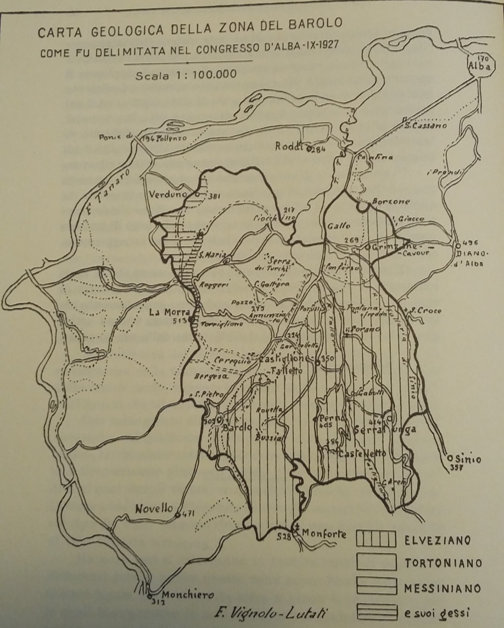
vignolo-lutati. sulla delimitazione delle zone a vini tipici, 1930, page 16.
[i] Lequio Formation (Serravallian): characterized by alternating layers of clayey marl and, to a lesser extent, sand. The soils are, therefore, silty with a fair percentage of clay and sand and very calcareous. They can be found in the Barolo area in the central southern part of Serralunga, on the eastern side of Monforte, and in Barbaresco in the area of San Rocco Seno d'Elvio and Treiso. (https://arnaldorivera.com/geologia-del-barolo)
[ii] Diano Sandstones (Tortonian): sandy layers originating from underwater landslides. The soils are therefore very rich in sand, less calcareous and with a low clay content. Widespread in the areas of Monforte, Castiglione Falletto, Barolo, Diano d'Alba.
[iii] Saint Agatha Fossil Marls (Tortonian-Messinian): it is the most common and widespread formation in the Langa of Barolo and Barbaresco. They are composed almost entirely of marly layers with little sand. The soils have an important percentage of fine sediments, silt and clay. They are further divided into: A) Typical: Composed almost entirely of silt. Present in the municipalities of Grinzane Cavour, Verduno, Santa Maria of La Morra and the lower part of Castiglione Falletto and Serralunga d'Alba, Barbaresco and part of the municipality of Neive; B) With sands: characterized by sandy layers interspersed between the marls. Widespread in Monforte, Castiglione Falletto and Annunziata of La Morra; in Barbaresco present in the upper part of the municipality of Barbaresco, Neive, Alba and the lower part of Treiso; C) With rock foliation: characterized by a high presence of clay. Present in the municipalities of Novello, La Morra and Verduno.
[iv] Gypsum Vein Formation (Messinian): characterized by the alternation of clayey marls and layers of gypsum in large crystals. The soils are, therefore, similar to the Saint Agatha Fossil Marls with rock foliation, but enriched by gypsum which increases the fertility of the soil. It is present on the west side of the hill of La Morra and Verduno.