
Looking for Mister N: the Langhe, La Morra & Lorenzo Fantini. Chapter II
/On the right bank of the River Tanaro you can see the Langhe divided into two parts, High Langa and Low Langa. In the Low Langa, especially in the area between Dogliani and Barbaresco, viticulture is not only flourishing, but it dominates all other crops. To the pleasantness and the fertility of those hills, human intervention and capital investment have added the most splendid viticulture which has completely changed the natural landscape. If from the plateau of La Morra you cast a glance at the huge area planted with vines in front of you, and look at those magnificent vineyards, wonderfully cultivated, and immensely productive, you won’t be certainly able to repress an exclamation of wonder. And your heart would break at the very thought of that piece of earthly paradise devastated by phylloxera!
Lorenzo Fantini, 1895
Summer. Belvedere of La Morra. I looked up from the book I was holding and cast a glance at the huge area planted with vines in front of me. From up there all those vine rows seemed to flow like surface oceanic currents, strong and fast, through an endless sea of green…
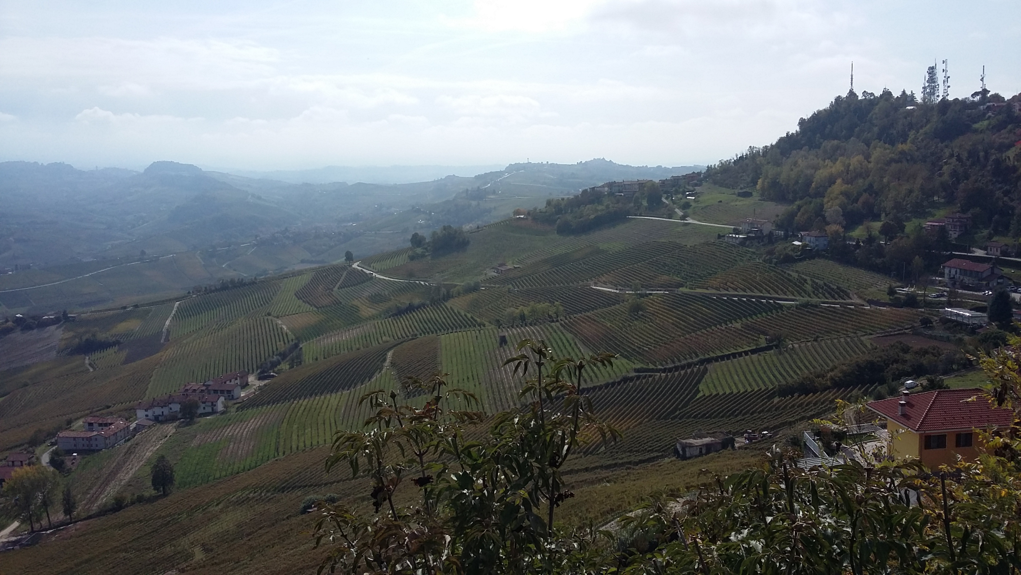
I looked more carefully at that beautiful landscape. In the midst of all that greenness I could see white houses with red roofs scattered across the hills, and dusty roads seemingly hand-drawn with chalk between one vineyard and another, but also shiny asphalt road bends, and rather flashy industrial warehouses along the road. Looking south, in the distance, the landscape looked a bit wilder: I could still distinguish the shape of a bush, a solitary tree, a grove confined to those hilltops which were too high to plant the vine. On my right, above the vineyards, five monumental cell towers rose from the woods on top of the hill... Landscape domestication was now complete: the earthly paradise seemed definitely lost, and replaced by an artificial one…
That vision took me by surprise. I had been there many times before, though never in summer, but I had always admired the outstanding natural beauty. Simply I had not noticed either the industrial warehouses or the shiny asphalt or the cell towers. Above all, I had not noticed the absence of biodiversity… How so? Maybe I was making a lot of fuss about nothing. After all, it was one of the most celebrated landscapes in the world, wasn’t it? I was surrounded by throngs of tourists visibly excited by the beauty of those hills, wasn’t I? Maybe I was wrong: the earthly paradise was still there. Or maybe in the past I had always been in a dreamy mood, blinded by the stunning beauty. Had I ever really looked carefully at those hills? Probably I hadn’t. Actually, I had never had a good reason until that day, when Lorenzo Fantini forced me to look at them with different eyes... How many TV reports had shown me the Langhe’s landscape from above? How many times had I admired those vine rows turning into brilliant shades of gold, orange and crimson? Everybody loves the magic of autumn’s fall foliage! Seen close up, those rows painted geometric patterns on the hillsides. But that day I got a very different impression.
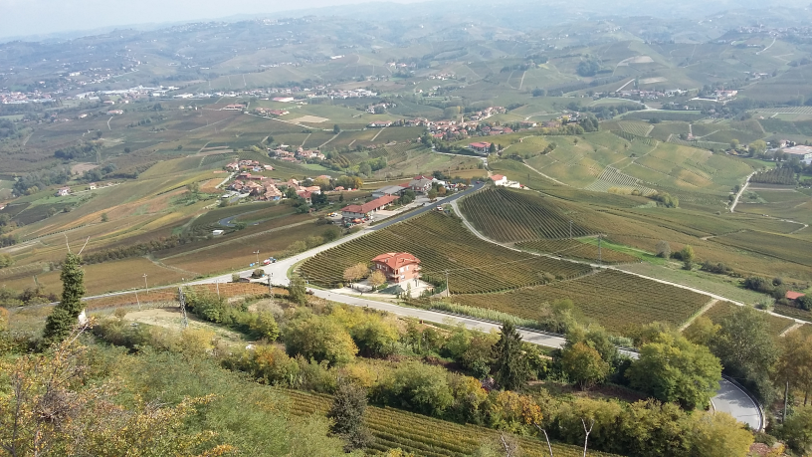
Everyone knows that mazes are meant to be disorienting and that it’s easy to get lost in there. Suddenly a thought flashed through my mind. Many (myself included) must have got lost in there if no one could see their true nature: those vineyards were not enchanted gardens, as I had always thought, but monoculture fields in an intensive agricultural landscape –a luxury monoculture, of course, but still intensive– which became invisible in winter and spread everywhere in summer. Clearly, their nature was hidden to human eyes by a powerful spell on those hills, if monoculture and intensive could be combined with the expression World Heritage...
All right, they were not maize fields or oil palm plantations… They were Barolo vineyards. Was I exaggerating? Of course, I was. Unless I could define what I was staring at from up there as the result of an agricultural process consisting in “growing one crop species in a field at a time” through intensive farming (“characterized” –as written on Wikipedia– “by a low fallow ratio, higher use of inputs such as capital and labor, and higher crop yields per unit land area”) in order to maximize yields and profits… Well, what was obtained from those vineyards was undeniably the maximum profit made from a single plant species. More precisely, from a single cultivar. Most likely, all those vines were Nebbiolo: in fact, Barbera and Dolcetto were rapidly disappearing from the Barolo and Barbaresco area, guilty of producing very few grapes, due to flavescence dorée, and therefore no longer profitable...
Vertigo. Anguish. With these two words the Italian writer Mario Soldati[i] would have expressed himself in front of that landscape in 1975 –that is, eighty years after Fantini and forty years before me. Yet, his description of those vineyards seemed to me closer to Fantini’s world than to mine: “I try to imagine these vineyards during the harvest. But the beauty of the landscape distracts me. […] I have never seen vineyards in such a wonderful position”. From those few lines emerged a sense of bewilderment mixed with wonder. At some point, he had been distracted by all that disruptive, dazzling, saving beauty which had somehow sharpened his senses. Unable to follow the thread of his thoughts, he had finally welcomed a sort of epiphany: “I feel that there’s a mysterious connection between the Alps and the vineyards”.
I closed my eyes and tried to feel it. In spite of everything, I thought I could perceive that stream still flowing below, like an underground river, through the roots of that ancient grapevine and the mineral salts of an ancient sea; and it floated all around me, like the thread of a spider’s web intent on capturing the light through the air currents and the vine shoots growing straight up while trying to reach out to the sky.
As you have surely noticed, I had not gone up that hill alone. My eyewitness, let me introduce him, is Lorenzo Fantini, surveyor and author of a book considered a cult by many Langhe wine producers.
“Have you ever read Lorenzo Fantini?”
Always the same question. Over and over again. My answer was always the same. No, I hadn’t. At first, I didn’t even know what they were talking about until, one day, a winegrower proudly showed me her personal copy of the “Bible of Langhe wine producers” and I could finally hold it in my hands. It was a volume bound in hardback sugar paper blue-colored cover, a facsimile of the original manuscript with no references later than 1895. As I soon discovered, the Monograph on Viticulture and Oenology in the District of Cuneo had been published in 1973 by the Ordine dei Cavalieri del Tartufo e dei Vini di Alba (Order of the Knights of the Truffle and Wines of Alba[ii]) in one thousand copies only and never been reprinted since then. Scrolling through it, it is clear that, unlike Mario Soldati (who, being a writer, liked recreating savory scenes for his readers), Lorenzo Fantini, surveyor, only cared about data and history.
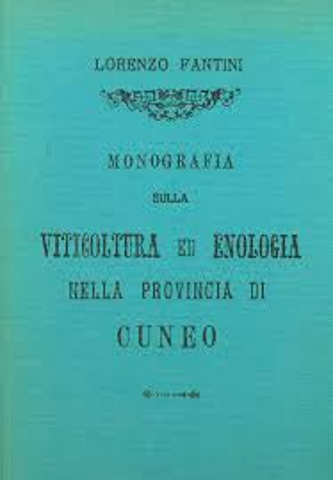
my own copy
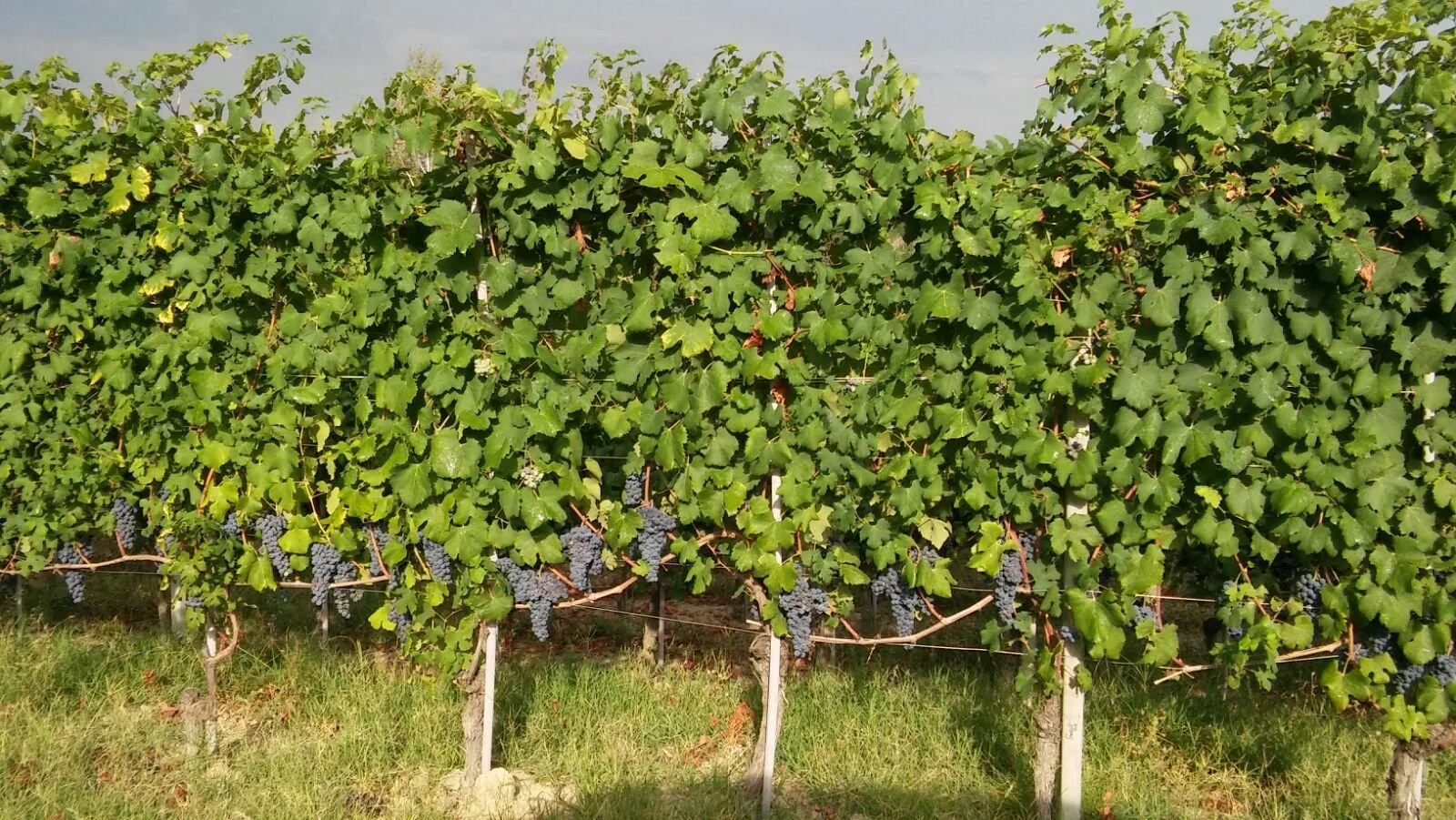
I parked my car along the road and sat cross-legged on the grass very close to a row of vines whose shoots were laden with bluish clusters. I placed the book on my lap and I opened it to page 92. On that page Fantini described Nebbiolo with slanted (and sometimes unreadable) handwriting: small, lanceolate leaves, light green in color, reddish-colored shoots with elongated internodes –thus preferring long pruning– medium-sized clusters if planted in fertile soil, but small if planted in lean soil, and medium-sized berries, not too tightly packed and never containing more than three seeds, with a fine taste and very rich in sugar (never less than 21%).
Clearly, for him to give a full description of Nebbiolo was not that hard. On the contrary, he seemed pretty sure of what he was saying: if planted on the valley floor, or above 450 meters [1,500ft] above sea level, Nebbiolo grapes could not ripen properly, and lost most of their characteristics, “such as the high sugar content and those special tertiary aromas which Nebbiolo wine develops with aging, attributable to ethers which seem to reside in the grape skin”. Over 450 meters [1,500ft], Nebbiolo had been replaced by other varieties: winemakers of his time were scared off by the possibility of getting clusters with red tips (i.e. unripe) “because the quality of the wine produced with them is poor”.
I looked up from the page and stared at those vines in front of me, planted at about 300 meters [1,000ft] above sea level, between Barolo and Monforte. They looked all the same. Like battery hens. Grapes were perfect. Too perfect. I looked hopefully around me in search of some trace of biodiversity. A wooded hillside. A colored patch of land. A tree. Nothing. I could only see a green, strong stream spreading everywhere and overflowing behind the hill. Now that all woods had disappeared, at least in that strip of land, even deep gorges and narrow valleys were being covered with vines. As for the high sugar content, winegrowers had nothing to fear, because all possible ripening problems had been successfully solved by global warming: no one had seen any red tips in the last thirty years.
Fantini seemed to have no doubts about the right soil, the right exposures, the right fertilization. Even in those days Nebbiolo preferred deep, clayey-limestone soils and only sprouted when sheltered from the cold south-western winds. He warned his contemporaries: “if it is not generously fertilized, Nebbiolo won’t produce much fruit”. Nebbiolo was planted on western and northern facing slopes only in the vineyards between La Morra and Barolo. I looked around me: as if in a cradle, vineyards were sheltered by the hill of La Morra from the humid north-western winds blowing along the River Tanaro, and by the hill of Monforte from the southwestern winds. Fantini seemed to know his stuff: to express his excellent qualities, the Prince of Grapes absolutely needed favorable soil and climate: even today it is penalized, emptied, impoverished by an exceedingly lean soil, as you would expect in case of unfavorable weather conditions.
On the next line a word caught my attention.
“Since this variety easily fails in fertilization and fruiting, becomes easily infected by Oidium and Peronospora, and requires strong fertilization and great care, unfortunately it tends to be restricted to those few privileged areas, where winegrowers can still find its cultivation profitable thanks to the very high price of the product”.
Unfortunately? Wait a minute. No one had ever mentioned that it was very susceptible to coulure[iii] and very sensitive to Oidium (aka powdery mildew) and Peronospora (aka downy mildew)! As far as I knew, Nebbiolo was a strong grape variety with no real weaknesses. Was it possible that climate change could have solved all those problems in one fell swoop, reversing its fortunes? Obviously, it was. In spite of what I saw around me, Fantini told us about a time when Nebbiolo had not been successful at all: after 1892 its price had dropped by 50%, favoring its replacement in less suitable areas with other more profitable vines, like Barbera, which, in the meantime, had become fashionable. To make matters worse, from 1883 to 1894 grapes fully ripened only three times: in 1887, 1892 and 1894.
On this aspect, Fantini wrote:
“For some years now, severe atmospheric disturbances, whose exact origin is unknown, have almost shifted our seasons, causing immense damage to the vineyards. Therefore, after the first warm spring in March and April that favors the vegetation (and triggers the new growth of shoots to begin too early), in May, and sometimes even in June, temperatures drop (along with flowers) and cold winds stop, and adversely affect pollination and fertilization, causing serious damage [...]. Today these meteoric events make cultivation of the most demanding vines very difficult”.
And, for the avoidance of doubt, the author remarked:
“Shifting seasons seem to be a matter of fact […] The very demanding vines, such as Nebbiolo, will inexorably disappear if the weather and thermal conditions (which we have been complaining for some years now) persist”.
A variety, which I considered invulnerable, was described as a species at risk of extinction just because unexpected changes in weather and climate had exposed a number of frailties that nowadays no one seemed to be aware of. Fantini’s apocalyptic prediction had not come true, but the gap between his description and what was in front of me was nothing short of amazing. Nebbiolo had not disappeared at all. On the contrary, he had survived and taken back everything that was his. His advance into the Langhe (and all over Piedmont) seemed irresistible, and unstoppable.
Observing the vines so closely was even more impressive than looking at them from the Belvedere of La Morra. Within a few years (from 2008 to 2015) the area planted with Nebbiolo grapes for Barolo had increased from 1,797 hectares [4,440ac] to 2,020 hectares [4,992ac], causing growing concern about over-exploitation of land among some wine producers.
While admiring the vineyards from the Belvedere, Fantini had taken the liberty to write an enthusiastic description of the land, praising human intervention and capital investment for it. But what exactly did he mean by an enormous vineyard area?
In 1895 procedural guidelines did not exist and no one had ever officially delimited the boundaries of the Barolo designation unequivocally. Sixteen years before though, Fantini had tried to draw up a list of the municipalities whose territories could be considered part of the Barolo area (“Barolo, Castiglione Falletto, Perno, and Castelletto Monforte, and part of the territories of Monforte, Novello, La Morra, Verduno, Grinzane and Serralunga”[iv]) only after having thoroughly studied it over the long years of [his] stay in the area and impartially performed, with the awareness of having done a good job, or at least very close to the truth. Three of the current eleven municipalities (Diano d’Alba, Cherasco and Roddi) were missing from the list, while Perno (now part of the Monforte area) was cited separately. Fantini also mentioned a wide divergence of view among those municipalities on the exact delimitation of the area intended for the production of Barolo:
“Such a distribution on the map, which I would more properly call the true territorial district of Barolo, will not be shared by all. But it’s from divergent opinions on this controversial issue that I have inferred that my delimitation is close to the truth. In fact, the inhabitants of Barolo are wrong in thinking that the area should be delimited within their village boundary because, while we can admit a certain superiority of their wines, we cannot reasonably deny the valuable quality of the wines produced in the other villages. Secondly, no one can claim that the territorial term “Barolo” delimits the land and the climate of this area geologically. Finally, even less right are those who, placed along the perimeter, would like to have the border pass behind them”.
His remarks proved the existence of a sort of boundary dispute: while the inhabitants of Barolo were trying to claim a monopoly on Barolo wine, those municipalities outside the Barolo area were trying to jump on the bandwagon. Those who supported a localist agenda in Barolo in favor of a restriction of the production area, should have come to terms with their defeat, while some of those who had been excluded, would have won in the long run.
The exclusion of three municipalities seemed to suggest that the area planted with Nebbiolo grapes for Barolo was less extensive in the past. In reality, things were not quite like that: in 1895 out of a total of 4,938 hectares [12,202ac] of surface, 2,536 hectares [6,266ac] (51%) were planted with vines, divided into about 2,000 hectares [4,942ac] planted with Nebbiolo grapes for Barolo (roughly the same as in 2015) and 536 hectares [1,324ac] – probably not suitable for Nebbiolo – planted with other varieties. Of those 2,000 hectares [4,942ac], 500 [1,236] were located in the municipality of Barolo (25%), where they represented 81% of the total area (that is, 621 hectares [1,535ac])[v].
Conclusions: in Fantini’s time, probably the land had been already exploited beyond measure – at least in the municipality of Barolo. His numbers seemed to confirm it.
What about Roddi, Cherasco and Diano d’Alba, whose vines would be converted to Nebbiolo grapes for Barolo only in 1980? Fantini had put them in the Alba district, a place with uncertain borders, on the right bank of the River Tanaro, which surrounded the Barolo area on three sides (west, north and east), and included:
“the territory of Roddi, the western side of the municipalities of Novello, La Morra, and Narzole only relating to the hamlet of Vergne, the hill of San Bartolomeo on the territory of Cherasco, the western side of Diano d’Alba with the hill of Carzello, and the hill stretching from the hamlet of Carzello towards the gates of the town of Alba”.
There were 1,293 hectares [3,195ac] planted with Nebbiolo grapes, meant to produce much simpler wines (aged for less time and released long before Barolo) but, unlike today, their diffusion was in sharp decline:
“However, I notice that the cultivation of Nebbiolo vines tends to disappear in those villages, or at least to retreat and concentrate in a few privileged areas […] Nowadays Barbera and Freisa are the fashionable grapes, destined to replace Nebbiolo”.
Fantini spoke of it as if it represented a significant alteration to Nebbiolo’s past supremacy: progress, trade and fashion were rapidly taking over. At that time, he could not imagine that flavescence dorée (a disease he had never heard of) would one day appear and put things right, wiping out all usurpers: lately, in the Langhe, Nebbiolo was rapidly replacing Barbera, Dolcetto and Freisa grapes or, maybe, it was just taking back his throne. Nebbiolo vineyards had colonized all the territory, that was a fact. But I had no idea whether over time they had been officially designated for the production of Barolo wine.
The number of hectares planted with Nebbiolo grapes for Barolo had remained unchanged since Fantini’s time. Could I say the same for the number of bottles produced? No, I couldn’t, until I first determined densities and yields.
To calculate the density per hectare, I needed to know the distance between rows and between plants. According to Fantini, the distance between rows could vary between 1.2 [3.9ft] and 8 meters [26ft], while between plants it ranged from 0.4 [1.3ft] to 0.7 meters [2.3ft]. Plowing the land with yoked oxen, the minimum distance between rows was 2.5 meters [8.2ft], while plowing with a horse, a mule or a donkey, it reduced to 1.5 meters [4.9ft]. That was, he thought, a very ancient agronomic rule suggested by Columella in Roman times. The distance between rows also depended on the degree of hillside slope and the exposure: “if the slope is very steep, rows can be narrower, since there’s less shadow projection of one row on the other”.
Fantini cited a vineyard in the French style (Guyot) cultivated using the Guyot pruning and training system with 10,000 plants/hectare [4,000/acre] on the Fontanafredda estate, in Serralunga d’Alba, and one with 13,700 plants/hectare [5,480 plants/ac] in Verduno. But in average vineyards there were probably around 3,500-4,000 plants/hectare [7-800 plants/acre]: farmers used to keep rows apart just to be able to grow wheat in between. Speaking of yields, however, Fantini indicated that 200 vines yielded about 200 kilos of grapes (441 lb), or one kilo per plant (2.2 lb)[vi] –that is, about 8 million 750ml bottles. With such low densities, producing 14 million bottles of Barolo would have been impossible.
Conclusions: the vineyard area had remained nearly the same, but density and yields had certainly increased. Climate (an uncontrollable factor) had changed too…
As someone wrote,
“The history of the vine is full of vines which either climb on the hills or descend to the valley floor, depending on whether Julius Caesar and Horace or the million inhabitants of imperial Rome are to quench their thirst. But it has never been in the Langhe vocation to descend from the hills”[vii].
And yet, the vines had descended. You only had to look around to see it…
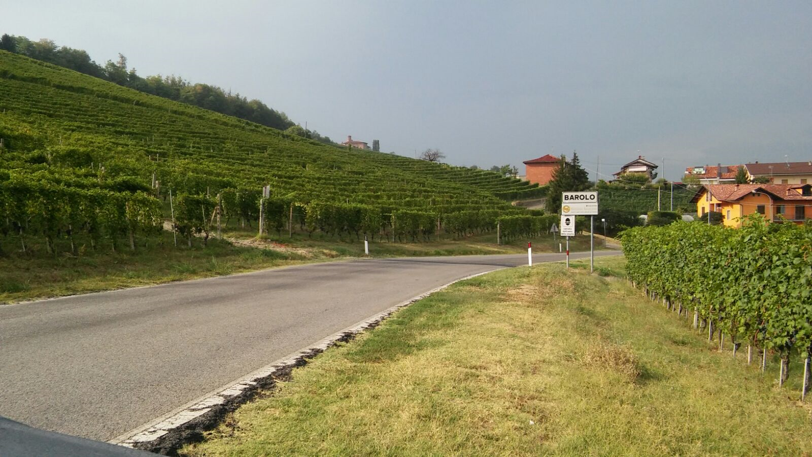
A sudden noise brought me back to reality. Some angry driver had sounded their horn. A car of landscaping tourists was slowing traffic behind –some busy trucks, but mainly vans. While driving carelessly along the winding road, they gazed at the landscape, exchanging ecstatic smiles and glances. At any moment they seemed to stop at the roadside and take a picture in order to immortalize their triumphant entry into that legendary land. I couldn’t help smiling. Funny how tourists, van drivers and I differently responded to that view. Mesmerized tourists stared out at that green ocean, with an expression of pure rapture on their faces, while busy drivers cast just a quick look, detachedly. What about me? I watched it with concern. Those hillsides blanketed with dense rows of vines made me think of a sprawling metropolis, full of soaring skyscrapers, rebuilt from the ground up, sparing no expense, on the rubble of a destroyed village after bombing. With all that abundance of vines, it was hard to believe that those hills had been almost completely abandoned.
Looking around now, you would never have guessed that on those hills Mister N had to face the Seven Plagues of Revelation. First came powdery mildew (1848) and downy mildew (1884), apparently as lethal as a viper bite, but fortunately each had an effective antidote (sulfur and copper). To follow, between 1884 and 1895, there was a long series of years with unfavorable weather, with hot springs and cold rainy summers. Then, the Great War broke out in 1914 and ended in 1918 with the Spanish flu killing those who had survived the slaughter. Finally, in 1929, on the other side of the world, the stock on Wall Street collapsed and a serious economic crisis occurred exactly when Phylloxera made its first appearance. At that point, the Langhe and Barolo had fallen on their face economically.
In November 1929, Professor Vignolo-Lutati wrote:
“Day by day we see Nebbiolo losing favor among winegrowers –at least in the Barolo area– as highlighted by the growing tendency to no longer renovate the old Nebbiolo vineyards or plant new ones, and to replace them with other varieties, especially with Barbera”.
Surprisingly, among the reasons for the decline of Nebbiolo, he did not mention the “well-known (genetic) defects of this noble grape variety: natural delicacy, sensitivity to cryptogamic diseases, slow ripening process, and lower yields[viii] than any other varieties”, but those ridiculous grape yields[ix] which were not sufficient to feed the people, a steady decrease in the price of Barolo grapes, a steady increase in the price of table wines, and a large drop in demand for luxury wines between 1905 and 1929.
A deadly creature had cast a very dark shadow over those hills:
“…the recent appearance of Phylloxera, with the consequent fears that it may irrevocably alter Nebbiolo’s character. In fact, once grafted on American rootstocks, not only Nebbiolo vines might no longer give us the classic Barolo as we know it, but they might also produce a kind of wine that is no longer appreciated as a table wine either”.
I closed the book and stared at the endless expanse of grapevines. Of course, they were all grafted. There she was, Phylloxera, wrapped in a hooded black cloak. I thought I could see her enter the enchanted valley forty years behind schedule, wield the scythe with an air of detachment, and reap victims like ears of wheat, erasing in an instant every trace of a glorious past that had remained unchanged over the centuries.
Maybe we had lost that ancient flavor forever.
[i] Mario Soldati (1906-1999), Italian writer and film director. In 1968, 1970 and 1975 he travelled through Italy and wrote about his experience in a single book called “Vino al vino”, untranslated into English.
[ii] See https://www.cavalierideltartufo.it/en/la-storia/. English page.
[iii] Coulure, or grape shatter, occurs when a grape berry fails to develop completely because of incomplete pollination.
[iv] Compare the list drawn up by Fantini with that of today's Regulations: Barolo, Castiglione Falletto, Serralunga d’Alba and parts of Monforte d’Alba, Novello, La Morra, Verduno, Grinzane Cavour, Diano d’Alba, Cherasco e Roddi.
[v] From 2015 to 2018 the acres of vineyards planted with Nebbiolo for Barolo went from 2,020 hectares [4,992ac] to 2,149 hectares [5,310ac]. Not even with the great success of Langhe Nebbiolo there’s a substantial difference in hectares of vineyards compared to 1895. In 2018, of the 607 hectares [1,500ac] cultivated with Langhe Nebbiolo on all the Langhe area (9,574 hectares [23,658ac]), about 343 hectares [848ac] are located in the 11 municipalities of Barolo. Subtracting the hectares in the municipalities of Roddi, Cherasco and Diano (about 20 hectares [50ac] not mentioned or counted by Fantini) from 343 hectares [848ac], equals about 323 [798], which, added to the 2,149 hectares [5,310ac], equals 2,472 total hectares [6,108ac] of vineyards (excluding the surviving Barbera, Dolcetto and Freisa vines), a number not far from the 2,536 hectares [6,267ac] mentioned by Fantini. Source: Barolo and Barbaresco Consorzio.
[vi] One hectare with 4,000 vines (2,5 acres with 1600 vines/acre) produced about 400 kilos of grapes (353lb) which, multiplied by 2,000 hectares (4,942 acres), yielded 800,000 kilos (1,763,698 lb), corresponding to about 8 million 750ml bottles.
[vii] Letter written by A. Abbona, N. Bocca, N. Chionetti, O. Pecchenino and M Sardagna (all wine producers from Dogliani) and published on www.slowfood.it/slowine on June 9th 2014.
[viii] The quantity of grapes per vineyard area.
[ix] 200-250 kilos per hectare, or 176-220 lb per acre.