
Looking for Mister N: Barolo, caput mundi. Chapter III
/“Countless villages connected by the indecipherable multiplication of hills and valleys, which are so full of constant unexpected twists and turns, that even the closest villages seem to be far away and the farthest ones seem to be close. Countless hamlets and villages, sometimes disguised small towns, whose names –some known, some legendary– recur on the wine labels. Because here everything revolves around wine. It is not the inhabitants who monopolize their product, but rather their product which monopolizes them. Vertigo. Anguish. What troubles me is this ultra-modern, impious, hypertrophic, vinous heart of old Piedmont: this enormous, visceral tangle of inextricable interests, trades, marketing and advertising, deafening hymns and condemnations which fall on deaf ears, celebratory speeches and secret invective, complicity and rivalry, dark (unclear) alliances and ruthless competition.”[i]
Mario Soldati, 1975
This is how the Italian writer Mario Soldati described the Barolo area in the autumn of 1975: a circular, indecipherable, tangled maze of roads, scattered with villages that, despite their size, had acquired worldwide fame and become a legend.
Forty years later, keeping those words in mind, I would have crossed the River Tanaro and found myself in the fairytale land of Otatani: Langhe! “Ou-ta-tà-nee” (that is, beyond the River Tanaro) is the name by which people who live on the left bank (the less noble one) call those who live on the right bank (the nobler one). In the distance, to my right, I could see villages perched on top of high hills, Roddi with its castle, and La Morra, while on the left side of the road there were vineyards, some arable land, lots of hazels, small groves.
To explain the aura[ii] surrounding the name of Barolo, Soldati had stopped in La Morra, but I had no doubts where my journey would begin: I passed the road sign for La Morra and Annunziata, and followed the road towards Barolo.
Those hills, low and rounded, seemed blanketed with one large vineyard which extended right up to the village gates. A place of great beauty. Suddenly, on the left side of the road, I saw two huge bleached oak rectangular boxes on top of each other, not perfectly matching. What the hell was that? A new art installation by some foreign artist attracted by the recent recognition as a UNESCO World Heritage Site? At first I stared at it in utter bewilderment, as if it was a boat on the roof of a house (or some absurdly out of place architecture in a dream), and after a few seconds I understood: it was a winery. In the shape of stacked wooden boxes.
What words had Soldati used exactly? Vertigo. Anguish. So he was right: it was the product which monopolized the inhabitants, not vice versa.
After about a mile I saw the town sign at the entrance of Barolo, but I didn’t stop: the cult wine producer Beppe Rinaldi lived at the other end of the road, just outside the village, on the left side, in a big house from the early twentieth century. It had not been easy to obtain his consent, but in the end, after months of hard bargaining, he had agreed to be interviewed as long as we did not talk about wine. He preferred to talk about history, and politics.
The appointment was around 2pm on a gray but warm day at the end of April. Rinaldi beckoned me to follow him into a room with lilac walls, and invited me to sit down on a pastel green sofa. He held an old book in his hands and the inevitable extinguished Tuscan cigar between his lips. Then he started to scrutinize my face carefully, as though he was trying to guess why I was there and what I expected him to say.
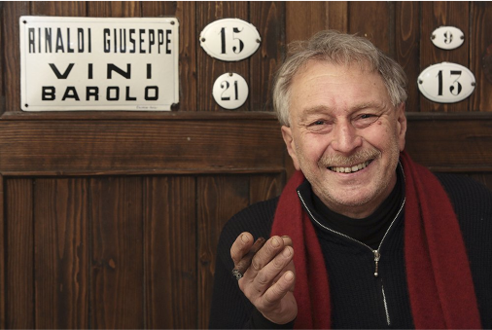
Credits: mauro fermariello
First interview with Beppe Rinaldi (April 29th 2015)
What is the relationship between Nebbiolo and these hills?
I have always wondered whether Piedmont has ever been aware –I mean, not only in the past, but even now– of what Nebbiolo has represented over time, because most people assume that Barbera is the most widespread grape variety. Nonetheless, from what little I have heard, read, verified, I have always thought it was Nebbiolo, partly because most of Nebbiolo grapes used to be vinified with residual sugar: mussant in French, ca mussa in our dialect. In other words: foaming. Nebbiolo was vinified as if it were Lambrusco, because food was high in fat and those who could afford protein foods raised pigs, not cows. Beef was a food for the truly rich: in fact, only the bourgeoisie, the nobles and the high clergy ate well. Common people could not. They raised two pigs, one for company and one for salami. At that time, foods used to be high in fat because animal fats were regarded as a suitable source of energy and served as fuel. Well, carbon dioxide in foaming Nebbiolo wines helped people dissolve animal fats in their mouths and washed their oral mucosa. Those wines weren’t too alcoholic. In my opinion, they were much easier to drink and digest than Barbera wines. And they also had a much longer lifespan, because Nebbiolo, unlike Barbera, has no acidity but tannin, which ensures a long natural preservation. Although they have disappeared now, once those foaming wines were very popular here. Some residual sugar was deliberately left in those light Nebbiolo wines from La Vezza, in Roero, in order to get this froth, and be a bit petillant. Of course, in the 19th century this vinification process already had –quite rightly– many detractors. At that time, oenologists (that is to say wine experts, those who had a good palate) shunned all this, also because wines with residual sugar could easily spoil. Besides, there were other contributing factors, such as how they took care of small wooden barrels. Taking care of wood is not easy –it implies the use of sulfur, sulfurization, hygiene... There were no other means. Unlike casks, those small barrels were easy prey for bacterial and mold infections (which produced large amounts of volatile acidity) because they were not used continuously and remained empty or unfilled for a long time. Only those who made large quantities of wine had casks.
The fermentations must have been shorter…
They were obviously shorter if one wanted to make those table wines. Instead, if they wanted to make wines meant to age, they necessarily had to convert all the residual sugar to alcohol. I’m not saying that they had to perform a maceration. I’m saying that they had to make dry wines. If you make dry wines, there’s much less risk of producing faulty wines. That’s why some people think that the first Barolos were sweet. Well, it’s false. I’ll tell you later why I don’t think this is so. Just as I do not think that it took Oudart to create Barolo wine... Oh, there’s a book[iii] on this, have you read it?
I’m afraid not...
I’ll show you later. In Piedmont most of Nebbiolo wines were sweet, but Barolo wasn’t, and Barbaresco wasn’t either. We need to make a short digression: when Domizio Cavazza created a wine called “Barbaresco” in 1894 (that is, he produced the first wines which would officially be called that), his dream was to call them all “Barolo di Barbaresco”, like “Barolo di Serralunga”, given that Barolos had more history. He had bought properties in Barbaresco, therefore he had very good reasons for saying that it was an area destined to produce long-aging red wines, because as long as you keep it, this kind of wine ends fermentation by itself even if you do nothing to complete it. End of my aside. What I really wanted to say is that this sort of awe, this psychological subjection (which, sadly, has always existed here) has meant that this Frenchman, Louis Oudart, has been credited for the invention of a dry Nebbiolo long-aging wine. Well, it is not true, because the Marquis Falletti had already made it long before Oudart. In my opinion, Barolo was born in Palazzo Barolo, their residence in Turin.
What makes you believe that?
Well, when I visited Palazzo Barolo and the Archive, I had the chance to see some cellar registers on which, long before the birth of the term Barolo, someone had written: Nebbiolo, old or very old, first quality, bitter. At that time, they preferred the term bitter, which is also beautiful, poetically speaking. The term dry came later. The word bitter had a broader meaning.
Yes, the Noble Bitterness, as the wine producer Christoph Künzli calls it, never banal, a distinctive character, though difficult to define… By the way, when was the term Barolo first used?
In 1864, after the death of the Marquise Falletti. The first labels bearing this term were printed in Bra and Milan, maybe in 1867, or in 1868. Let’s say around 1870. By the way, the Marquise had made Barolo wine famous in all Royal courts of Europe in the 19th century, and had also won many awards in wine competitions. It was widely believed that her wine was very good and could compete with the great long-aging wines of France. But you probably already know all this stuff…
No. I’m afraid not. So Oudart did not invent Barolo, did he?
Absolutely not! Look, it really annoys me to hear this story repeated… Those who support it show no dignity, no self-respect, and a lack of awareness of their own history... But it is not surprising, given that we are still not a nation today. Spreading awareness of how noble our wines are is a very recent thing… When I say awareness, I don’t mean a form of parochialism, but rather a manifestation of the dignity of rural Piedmont and of the nobility of the wines from here. That’s why credit is given to people, such as Louis Oudart, who, in my opinion, didn’t have any. I do not mean to deny Oudart’s other merits. He had a great palate. He was an expert in viticulture and winemaking. He dreamt of making champagne here. Actually, he made it. Do you know that in 1833 he had a firm called Oudart et Bruché in Genoa? Champagne was already a legend and, after all, he came from Reims… Moreover, he also worked in Pollenzo for the House of Savoy, and collaborated with Staglieno, who is considered the first Italian winemaker[iv]…
And then, from 1847 he worked for the Count of Cavour[v], in Grinzane.
Correct. The Benso, Cavour’s family, had a large property, maybe 1,800 hectares [4,500ac], mostly vineyards, and two farmhouses, called “Camilla” and “Gustava”. As you know, Cavour was a great expert in agriculture. He dreamt of organizing an efficient agricultural power in Piedmont, by seizing lots of properties which, he believed, were poorly managed. After that, in mid-19th century, powdery mildew arrived here. A real scourge. Then it turned out that sulfur had healing properties…
Powdery mildew first appeared in 1848, and then, in 1884, downy mildew…
But you already know everything…
Unfortunately not. Did phylloxera arrive later?
Yes, it arrived much later. Let’s say in the 1930s. Speaking of powdery mildew, remember that book I advised you to read? Well, in that book it is written that Oudart was not only an expert in viticulture and winemaking, but also a great negociant, a skilled seller, very clever… He began to trade sulfur. He might have rationed it. A smart guy. He also traded in grafted vines. Grapes, wine...
Therefore, Oudart was the classic foreigner who comes to town and knows it better than anyone. Is that why they thought he was a winemaker?
I think so. Look at this book: Viticoltura teorico-pratica (Theoretical-practical viticulture) by Ottavio Ottavi. It is a second edition, printed in 1893. Here there’s written something very interesting. About Nebbiolo, he describes the vine, lists all its names, explains where it is cultivated, and finally says: «it suffers from the damp cold during flowering… Wine: austere, fragrant, very rich in esters; if it ages, it is dry; alcohol 13-14%; acidity 6‰, or even just 4.5 in aged wine… It is called Barolo when grown in Barolo and La Morra; instead, some call “Nebbiolo” the sweet wine made with these grapes. Dry Nebbiolo can be exported. It distinguished itself abroad. Sweet Nebbiolo is often a sparkling wine, rejected by intelligent people». Beautiful, isn’t it? Evidently, Ottavi had already developed the idea that sweet sparkling Nebbiolo should be rejected by clever people. I’ll show you another book. Speaking of Oudart, there’s always been a great deal of confusion, because the Oudart were two. One is Louis Oudart, and the other one… I had this book bought in Paris: it’s by the other Odart, Alexandre-Pierre, famous ampelographer: Ou Traite des Cepages, 1862 edition. He also talks about Nebbiolo. See? It says: Barrolo, because once it was also written with two r’s: “This Gamay, very productive, wine of mediocre quality…”.
Not exactly flattering, I would say.
He calls it Gamay. Asshole. And then he starts listing its names: «nebbiolo bianco, melasca bianca, nebbiolo, nebbiolo maschio, piemonte, melasca, spanna, picoutener… nebbiolo grosso, melascone di Biella, spanna grosso, nebbiolo gentile, nebbiolo c., melaschetto, spanna piccolo…». The proliferation of names is probably due to viruses and mutations… You see? Count Odart. It has nothing to do with Louis Oudart…
Interesting. Since when have you dealt with it?
I haven’t. I hope to have some time to read in my old age.
With Barolo, I mean…
Oh. My family have grown grapes and produced wine for six generations. My great-grandparents were first winegrowers, then winemakers. My grandfather, my father, me, and now my daughters, all of us have always lived in Barolo… I was born in 1948 and the world was very different at that time. I consider myself a post-war child, although I was born in a privileged area…
Who was the first to bottle in your family?
In the past almost nothing was bottled. Wine was sold loose in barrels, in demijohns, at Monchiero or Alba station, and it was nice to sell wine from the cask, because bottling and selling bottles is a big pain in the butt. With all the laws and regulations issued in recent years… the unwieldy bureaucratic organizations… I think that my grandfather was the first to bottle. I never knew him. He died two years before I was born, in 1946. My father loved Barolo a great deal, therefore he was a staunch supporter of its revival. Every generation believes that it has understood everything, that it has discovered everything. It is very hard to be humble and say: what happened before us? Let’s say that Barolo was already fairly famous when the Marquis Falletti owned this fiefdom, which consisted of 1,200 hectares [3,000ac], mostly vineyards. There was a lot of viticulture here…
Or just viticulture? Reading Fantini, it would seem so…
No, not only viticulture, nor only Nebbiolo. It was a land mostly based on self-sufficiency. Hay was produced for cattle. There were also sheep. And orchards, peach trees, apple trees, hazelnut trees. Meadows. Corn from the hills. And lots of woods. There’s a very interesting book written in 1929 by a certain Vignolo-Lutati, entitled Le Langhe e la loro vegetazione (Langhe and their vegetation). When I read it, I realized how many trees there were once. Consider that the only way to keep warm in winter was to burn wood. We needed wood. That’s why owing a forest was considered an asset. It meant having a good winter. So much so that, there’s a letter sent from Palazzo Barolo and addressed to the Marquise Falletti while she was in France, in which she was asked for permission to cut down trees on her estates as the people who lived in her fiefdom were freezing. In response to that letter, she obviously agreed. The woods were a source of wealth from other points of view as well, because the supports for the vine were all made with reeds and stakes. People went to Alta Langa to buy chestnut wood. When Robinia pseudoacacia or black locust (which is native to North America) was introduced here, it produced a revolution because it grows rapidly, spreads asexually, and is also a weed. Therefore, it was also a damage to biodiversity because Robinia soon replaced all other tree species. Not only stakes were made of Robinia, but also small barrels and tubs. We have always harvested in the garòs…
What is a garòs?
It’s a small tub. I’ll show you one later. They were made of black locust or chestnut.
Why did you have to use tubs?
Well, until the 1980s there were many bad harvests, with prolonged autumn rains. Therefore, Nebbiolo grapes were harvested unripe or moldy, that is full of botrytis. Now, Nebbiolo berries have a thick, elastic skin which resists much more than that of Dolcetto, Barbera and Freisa. Nonetheless, even if its skin resists persistent autumn rains, however, at a certain point, because of the high humidity, it deforms, splits, and starts dropping juice. That’s why you cannot use a woven chestnut basket. You have to use the tub, otherwise you’ll lose some unfermented juice. I remember those harvests in late October, early November. At that time, when you cut the grapes off the vine, you had to be very careful while laying them in those tubs, otherwise they would have crushed and leaked liquid. Then, suddenly, temperatures started to rise and harvests to be brought forward. At that point, those tubs were no longer needed.
When did Barolo start being produced in a different way?
It is true that, even then, there were already three or four wineries producing large quantities of wine. But, all in all, they were small quantities compared to the number of bottles produced with Moscato grapes. Those were large numbers! Here there have never been large numbers, also because it’s impossible to produce a hundred million bottles with Nebbiolo. And even more so, it was impossible at that time.
Why was it impossible?
First of all, because Nebbiolo was grown only in those few sites suited for Nebbiolo. Today there is a lot of talk about soil, marl, exposure, but once upon a time the old folks said “this is a site suited for Nebbiolo”, which summed up everything there was to say. In those soils there was marl without too much silica.
Are you saying that marl with too much sand is not good for Nebbiolo?
Correct. On sandstone sedimentary rocks there are some hill ridges where there is a lot of sand. That kind of soil is not suited for viticulture. First of all, because it is all scheletro (that is, very coarse sand with a diameter over 2 mm). Secondly, because that kind of soil drains most of the water, which is good for Dolcetto and Barbera, but not for Nebbiolo. On those coarse-textured soils vines suffer from drought. And vines subjected to water stress never bear good fruit. Inevitably, their grapes produce lean wines, with little color, little acidity, little of everything.
I got it. Since sand drains all the water, it washes away nutrients in the ground.
Exactly. There’s no organic matter left. And Nebbiolo does not ripen well. There weren’t many sites suitable for Nebbiolo. They were special places. In any case, on those unsuitable soils they could plant some other varieties. There were also some Moscatelli here, besides Dolcetto, Barbera and Freisa. I still make a Freisa wine...
Today, however, Nebbiolo is grown where it once would never have ripened.
One of the worst things that can happen to Nebbiolo is not reaching full ripeness, because you make a cheap wine, which has no aging prospects. Among our fathers there was the fear of harvesting unripe Nebbiolo. Those who grew it on unsuitable soils harvested red grapes, that is unripe. Either the raw material is excellent or, otherwise, you can’t make a great Barolo.
Fantini also talks about bunches with red tips. Can we say that the situation has changed only thanks to climate change?
Well, in my opinion there are other contributing factors. The great replanting with grafted vines and the rebirth of Nebbiolo were only possible after the Second World War thanks to the deep ripping which mechanically breaks up compacted soil layers. Before the war, farmers used to rip soil with steam engines. When diesel engines appeared (sometimes salvaged from the American war remnants abandoned here) farmers started to rip soil with steel ropes. In the main square I placed one of the first mechanical plows that arrived here. Look at this picture: the boy on the plow is my father. Think for a moment what it once meant to plant a vineyard… which, by the way, lasted a lifetime. Actually, two lifetimes. The graft has shortened the lifetime of vines by at least half, because it causes incompatibility between the vine and the American root. Ungrafted Nebbiolo vines produced less, but lived much longer, at least 150 years… Then, the more productive plants were chosen for mass selection, with the mutual agreement of nurserymen and winegrowers, as both wanted to produce quantity. They had lived in poverty since childhood, so quantity mattered.
Has the pruning system changed too?
Of course! And the training system too! Once there were many old branches here, because winegrowers used to raise their vines with the so-called collane (literally, necklaces) which produced little though. Then, one day, the Guyot method (which is an industrial training system) arrived.
Industrial? What do you mean with that?
Industrial in the worst sense of the word, I’m afraid. Because the Guyot method[vi] applied to a vigorous vine like Nebbiolo is a barbaric way of treating plants. Cutting back nearly all the vine’s prior growth is a violent way to castrate its vigor. It tries to tame it. To treat such a vigorous plant so brutally is violence to me. Nebbiolo is an unstoppable vine. It is necessary to carry out repeated winter pruning and green pruning, in order to contain its vigor and keep the permanent trunk high[vii]. You cannot treat it like Pinot Noir (whose trunk can be kept low). The land here is deep and fertile. It’s not pebbly. If you don’t let it go, inevitably something gets lost along the way. I think that even in wine some qualities are inevitably lost.
Have you ever tasted a Barolo produced before the appearance of phylloxera?
You mean a Barolo wine produced from ungrafted vines before 1930s... I must have tasted it. Definitely. I think it was better. I think so...
Fantini also talks about necklaces, but he seems to consider them archaic and doesn’t seem to be interested in them at all. Were there still any in 1895?
Oh yes, there were indeed. Those necklaces are a sort of training system that leaves the vine free to express its vigor, and the sap to flow. This is because you have so much old wood. At the time, branches could stretch up to 7-8 meters [23-26ft]. But there was a minus: pruning was very difficult. There was the idealization of the great pruner, also because Nebbiolo has low distal bud fertility. But this old system, which we can define as spurred cordon, was THE system.
I therefore imagine that the Guyot method, being a much simpler system to manage, had little difficulty establishing itself…
You are right. When the Guyot method arrived, it changed everything, because mechanization had started too. When vines died, a branch was buried in the ground to have a new vine through propagation. With the necklaces, instead, vines had three, four large branches (similar to snakes), and grape growers had to keep them high enough. They could not keep them close to the ground. You can’t keep Nebbiolo either too high or too low. I believe it was the Celtic system.
Celtic… system? How so?
The Celts did not have pruning shears to handle the vine. They had sickles. If you have necklaces, you can manage them with a sickle, because vines with all that old wood, I mean, large in diameter, are very sturdy. Branches could be eight, ten years old. You are familiar with the Celtic sickle, right? You pull and you don’t tear everything. Instead, with Guyot, you tear everything up, even the two-year-old branches. You rip them off the trunk.
So, in summary, after the Marquise’s death, what are the main factors that put viticulture here in the Langhe to a test?
The appearance of vine diseases, on the one hand, and the depopulation of this area (due to the two world wars and the Spanish flu) on the other, led to the abandonment of many vineyards. A strong emigration followed, especially to South America. Some of my family also escaped. There was a shortage of manpower. Then, there were several consecutive years of hail. Finally, when phylloxera appeared, all the vineyards were necessarily replanted with vines grafted onto American rootstocks. Thankfully, mechanization came to our rescue, otherwise everything would have been abandoned.
Has industrialization been idealized here too?
Of course! Sadly, Piedmont chose to be industrial, in Alba with Ferrero, Miroglio and all related industries. Many of my schoolmates went to Turin and became workers at FIAT or bakers. Why such a choice? Well, because there had been a denigration of peasant work. I think it was a cynically planned choice, even in privileged areas like this. The boom in industry was such that the local population was no longer enough. Later, Ferrero and Miroglio were so enlightened that they organized the bus to pick up the farmers and their children and take them home, where they continued to cultivate vineyards, as well as raise sheep.
How were the harvest from the 1950s onwards?
Uhm, let me think… In the immediate post-war period there were seven consecutive years of hail. A scourge. That’s why so many people have fled from here as well. There was a long period of very strange harvests, in which Dolcetto grapes were worth more than Nebbiolo grapes.
And then, in the 1980s, temperatures started to rise. When did Barolo take on a hedonistic connotation?
I think it was already a luxury product in the 19th century. Its ability to become ennobled with aging –something very rare, because only four or five grape varieties in the world give wines that acquire such noble perfumes, ethers and esters… This ability had been discovered much earlier, at the time of the Marquis Falletti. At Palazzo Barolo, when the Marquise died, there were no less than 44 oak casks full of wine, one of which held 200 hectoliters –a sign that, at that time, they had already understood that Nebbiolo had to be left to age, and that the oak casks had to be taken care of. Keep in mind that many people today think that all wines were once bad. Instead, in the mid-nineteenth century there were already those who knew how to make excellent wine and keep the wood clean, since the use of sulfur was already known.
In your opinion, what causes this belief?
Ignorance. Arrogance. Self-promotion. Self-referentiality. I find all these things extremely annoying. People who don’t research their area, while undoubtedly privileged, are sad…
Are you implying that some people think real Barolo was only created in the 1990s?
Let’s take a step back. What changed everything here were the rules and regulations: the Register of vineyards in 1954, the Register of DOC (Designation of Controlled Origin) wine in 1966, the DOCG (Designation of Controlled and Guaranteed Origin) in 1980. The Senator Paolo Desana. The formation of a wine consortium among the Barolo and Barbaresco producers, which is called “Consorzio di Tutela”, that is, providing legal protection to those wines. It was born with this word: protection. Sadly forgotten. Today they want to deny the purpose for which it was created. Well, since at that time there were no rules, and none was aware of the uniqueness of the Nebbiolo produced in these areas, producers used to pass off as Barolos and Barbarescos usually mixed with southern wines. At first, they wanted to imitate Burgundy. Many from here have visited Burgundy, but on their return their only comment was: how backward they are!
I’m afraid the lack of protection isn’t limited to wine...
What is happening here now, the terrible, shameful wounds that have recently been inflicted on these hills (I’m not speaking only of building construction, but also of violent viticulture, monoculture, far too much) is due to the fact that those people have not noticed that the landscape belongs to everyone. The landscape is a collective value to be protected, and also a privilege, because I think these hills are more beautiful than those in Burgundy. Yet, in those villages you can’t see anything that disfigures the landscape. Those who go there without a humble attitude, when they come back, they say: their cellars have such molds, cobwebs, dirty floors… This is true privilege! But their history is much older than ours: they defined their wine quality pyramid in 1936, while we have not yet arrived at defining it today. Nobody wants it anymore. Fantasy names are preferred over real, historical names for hills. For personal gain.
***
I remained silent. I knew what he was talking about. Instead of adopting the Burgundy wine classification system, in 2009 the Barolo Consorzio had decided to renounce the rank classification of vineyards and to horizontally distribute the 177 additional existing geographical mentions (MGAs, the Italian version of the French crus). No pyramids. A shareable choice, apparently egalitarian and democratic, which in fact had eliminated the superiority of the historic vineyards over the others, with some significant consequences. One of these was that a famous cru like La Bussia, historically divided into three sub-zones (Sottana, Soprana, Gabutti) had become a single hill with much wider boundaries. They had therefore expanded their range of action, perhaps only to avoid disagreements, retaliation and appeals from Barolo producers, but more likely to make room for more wineries now that Barolo wine had become a very profitable business. In Burgundy –the touchstone for those who want to produce luxury wine –the rules had already been established in 1936. Unfortunately, no one had thought of setting up the Barolo wine classification system before the 1980s (when the limited area of land under vines and the interests at stake still made it possible) leaving it to future generations...
***
The interview had stopped in the middle of something. Annalisa, his wife, peeped through the door with a questioning look and only then I checked my phone and realized that it was already 6.30pm. It was so late! I jumped up ready to leave (I had a two-hour drive home!) but Rinaldi seemed in no hurry.
“Come, I’ll show you something...”
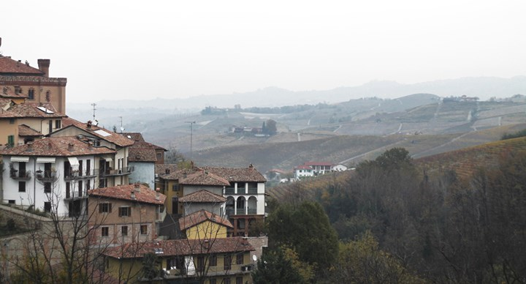
He led me to a terrace from which we could admire the village and the surrounding vineyards. A vineyard was slowly sliding down the opposite hillside.
“See that?” he asked, pointing at it. “Quite a mess, huh?”
We remained silent for a few minutes, leaning our elbows on the balustrade of the terrace, and our eyes fixed on those vines. On that hill, he said, there had always been woods, trees and bushes... He said no more. Of course, it was not the only vineyard planted where the elderly would have never dared. Scattered throughout the Langhe area, there were many. Sometimes they too slipped, although global warming (and the decisions of the Barolo Consorzio) had magically transformed them into crus.
***
Whom could I entrust with telling the story of Barolo if not to Beppe Rinaldi? In 2015, of the three cult producers of traditional Barolo in my personal pantheon, Rinaldi was the only one left alive: Bartolo Mascarello had passed away in 2005, followed soon afterwards by Teobaldo Cappellano in 2009. Beppe Rinaldi was not only a great interpreter who had always remained loyal to his own principles, to the story of his family and to his land, but he was also a great connoisseur of the territory, and a lover of history and books.
He seemed to have two strong convictions. In the first place, he believed that Nebbiolo had always been the most cultivated winegrape in Piedmont, vinified in two versions: with a residual sugar to degrease pork served on common people’s tables, and dry to match with beef served on the nobility’s tables. Barolo was therefore born as a luxury wine, not at all sweet, and least of all invented by a Frenchman: the real inventors of the bitter, old or very old Nebbiolo, were the Marquis and the Marquise Falletti, certainly not Louis Oudart. Its usual attribution to a Frenchman was certainly useful for building a suggestive link between Barolo and Burgundy wines in the collective imagination (which, in fact, accepted and made it its own), but it also revealed how deeply insecure people living on those hills felt about the real value of their land and its history: while the Italian Barolo created by the Marquis Falletti had a provincial, faded and unbearably old-fashioned aura, the one by Oudart sounded much more noble and charming. Behind that story, however, there was a Frenchwoman: Juliette Colbert de Maulévrier, married in 1806 to the Marquis Falletti. Proof of this is that passage written by Count Giorgio Gallesio on his return from a visit to their cellars on Sep. 19th 1834:
“The grapes in Barolo (the zone) are Nebbiolo and Neiran; with these two grapes are made the famous Barolo wine, of which however Neiran only accounts for about one tenth. Barolo wine lasts many years and the marquesses of Barolo conserve it with the aim of sending it to the Court of Turin and to others. In this village, indeed, there is a belief that in order to have the finest wine it is necessary to make it entirely out of Nebbiolo; otherwise it is mixed with Neiran to give it color, Nebbiolo alone being too light and sweet. I have visited the cellar of the marquesses of Barolo: It is a great semi-subterranean area with vaults for the keeping of large barrels, above which is the cuverie. There were 30 botti [large barrels], most of them containing wines for aging: I tasted the 1833 vintage and it was harsh and ungiving; that of 1832, on the other hand, was soft and succulent.” [viii]
In those same years Oudart was still engaged in the experimental production of champagne-like wine in Pollenzo. He had not yet tried his hand at making wine with Nebbiolo.[ix]
Secondly, Rinaldi believed that on those hills there had never been either only viticulture, or only Nebbiolo. To prove the presence of lots of trees, he had cited two sources: a letter addressed to the Marquise (prior to 1864) and an essay written by Vignolo-Lutati (1929). Halfway between them was Fantini’s voice, who seemed to confirm the presence of forests and trees in the Barolo area.[x]
Fantini had described a phase of economic recovery between a sort of Age of Innocence (an archaic phase swept away by the appearance of powdery mildew in 1848) and the Fall, a phase of severe economic crisis, unleashed by the outbreak of the Great War (1914) and made worse by the arrival of the Spanish flu (1918) and the appearance of phylloxera (1929). In between (1861-1914) there had been the Italian Risorgimento[xi], a sort of Age of the Phoenix when people and vineyards had risen from their ashes. A period of recovery, characterized by the diffusion of rational methods and intensive monoculture.[xii]
If economic crises make forests expand, on the contrary, economic recoveries make them retreat to make room for new vineyards:
“Very numerous are the newly planted vineyards on deforested land, particularly in the district of Alba. Walking through it, you can see hundreds and hundreds of hectares which were covered with grass or with few pine groves only a few years ago. Now they are luxuriant vineyards, highly profitable for wine growers and investors”.[xiii]
Between the 1930s and the 1950s, viticulture could only recover thanks to the massive replanting of European vines grafted onto American rootstock. On the other hand, the massive replanting was only possible thanks to the advent of the mechanization of agriculture. Every cloud has a silver lining, Rinaldi seemed to conclude: with just an ox replanting would have been impossible.
Little by little, the grafted vines had replaced the ungrafted ones, and the Guyot training system had supplanted the so-called necklaces. According to Rinaldi, they were the ancient Celtic training system. Grafting was a necessary evil: rather than lose all viticulture, better solve the problem with vines which had coevolved with that insect -the phylloxera- for millennia. In a nutshell, an American plant had solved a European problem caused by an American insect, arrived in Europe due to the intensification of Atlantic maritime trade. Since then, the American rootstock has been acting as a filter (or interpreter?) between a soil and a plant that had interacted for millennia. Moreover, in the end of the 19th century a new pruning system had arrived from France too. As far as I knew, the Guyot system was the best existing system for a vine, such as Nebbiolo, whose only fertile buds are the apical ones. But Rinaldi’s words offered me a very different story.
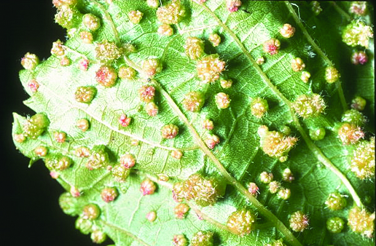
Once upon a time there was a Vine which produced very few grapes and lots of old branches. Energy flowed up from the roots to those inextricably intertwined branches. Yet, their riddle could be solved. How? The ancients simply followed their instinct. They used the right tool: a sickle. Those vines were over a hundred years old. Therefore, their juice was an elixir of long life, a distillate of mineral salts, sugars and acids drawn up through the roots, running through those tangled branches, up to the apical buds, before they turned first into flowers, and then fruits...
Alas, one day, a lethal enemy had come. Progress had done the rest. On one side the American rootstock had broken a delicate balance by interrupting a millennial dialogue between ungrafted Nebbiolo and that soil: as a result, grape production had increased, while the life of plants had halved. It was the price to pay. On the other, a French industrial training system had tried to contain that irrepressible vine by depriving it of its vigor with a pair of scissors.
Perhaps that lethal synergy had erased, in one fell swoop, an ancient flavor, a unique perfume and a whole range of emotions, forever. For Rinaldi, that was the Age of Regret. No doubt.
[i] M. Soldati, Vino al vino, Milano: Garzanti, 2011, p. 647.
[ii] In Italy we call “mito” the idealization of something that assumes, in the consciousness of posterity and/or contemporaries, an almost legendary character and proportion, exerting a strong power of attraction on the imagination and feelings of a people or an age.
[iii] ANNA RICCARDI CANDIANI. Louis Oudart e i nobili vini del Piemonte. Storia di un enologo francese. Bra: Slow Food publisher, 2011.
[iv] Paolo Francesco Staglieno (1773-1850) managed the so-called “Agenzia di Pollenzo” from 1836 to 1846. More or less in the same years, he worked as a consultant in Grinzane.
[v] Camilo Benso, Count of Cavour (1810-1861) was an Italian politician, businessman, economist and noble, and a leading figure in the movement towards Italian unification.
[vi] “This is a ‘renewal’ training system, where the fruiting side-branches (arms) are pruned out every winter, and new ones trained horizontally to replace them and carry the coming summer’s crop. The vine has a short permanent main stem (leg) and either one (single Guyot) or two (double Guyot) fruiting side-branches (arms), trained along the lowest horizontal wire. Fruit-bearing shoots sprout from these horizontal arms and are trained upwards between the wires above through spring and summer. The horizontal arm(s) are then pruned out every winter and replacements trained in.” See: https://www.rhs.org.uk/fruit/grapes/guyot-pruning-system.
[vii] https://extension.unh.edu/resource/pruning-and-training-grapes-home-vineyard-fact-sheet
[viii] G. GALLESIO, I giornali dei viaggi. Transcription, notes and comment by Enrico Baldini. - Firenze: Accademia dei Georgofili, 1995, p. 378. Translated by Nicolas Belfrage, quoted in: https://worldoffinewine.com/uncategorized/barolo-a-love-story-4923447 (June 14, 2016).
[ix] A. RICCARDI CANDIANI, Op. cit., p. 32.
[x] Out of a total of 4938 hectares, 49% (2402) of the surface was wooded, while in the municipality of Barolo the wooded area covered only 19% (121 hectares out of 621). See note 18.
[xi] The unification of Italy, also known as the Risorgimento, was the 19th-century political and social movement that resulted in the consolidation of different states of the Italian Peninsula into a single state in 1861, the Kingdom of Italy. Inspired by the rebellions in the 1820s and 1830s against the outcome of the Congress of Vienna, the unification process was precipitated by the Revolutions of 1848, and reached completion in 1871 after the Capture of Rome and its designation as the capital of the Kingdom of Italy.
[xii] “Today cultivation tends to become intensive everywhere, as the most intelligent class takes an active part in the work, studies the choice of vines…”. (FANTINI, Op. cit., p. 55.)
[xiii] Op. cit., p. 175.